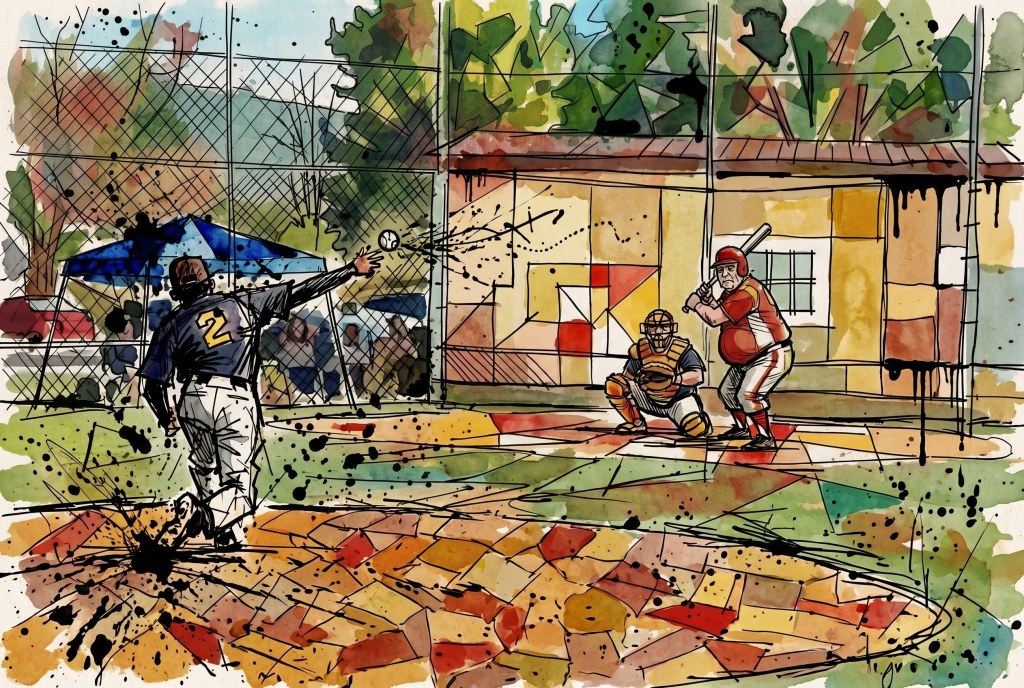
I venture to say that you haven’t really watched a baseball game until you’ve seen a group of 35-plus-year-olds trying to play on a neglected field with patches of grass growing where dirt should be and the grass itself so long that it instantly deadens any ball hit on it, regardless of exit velocity. It’s not, on its face, good baseball, nor is fit remotely entertaining to watch, nor is it even guaranteed that each team will have enough players to field a squad any given week, but you won’t find another game where the guys are just happy to be there, playing at all. I’m talking about the Shenandoah Valley Adult Baseball League (SVABL), which I’ve been participating in, or limping through, for the past couple of summers.
I played in one game last year, as a trial run to see how I liked it, then went all in this year, forking over a painful-but-worthwhile $250 to play a three-hour game each Sunday, May through September, often on fields over an hour away. My five-year-old son, also the bat boy, asked after seeing me in a uniform for the first time: are you a refessional (translation: professional) baseball player? I told him, no, buddy, I’m the opposite: I have to pay to play, that’s how much I love it. Those guys you see on TV, they’re making millions of dollars: how many of them do you think would still be playing if they were losing money? I think not many.
Until last year, I hadn’t played baseball since the summer after my senior year of high school, 2007, when I was a member of an American Legion team in the Richmond area. I hadn’t even played softball since 2015, and before last summer, I’d accepted the fact that I’d never play baseball again. But then a friend named Marc casually mentioned, while watching our sons do taekwondo at a place called Dong’s, that he was part of an adult baseball league; he asked if I wanted to give it a try. So I did, and in that first game, in which I didn’t even have a proper uniform, I struck out and made a few errors, but also got a hit and made a good play or two in the field; just like that, all of the joy I once felt while playing a silly kids’ game came rushing back. The baseball bug had wriggled its way into my veins and my flimsy immune system was defenseless against the virus.
There’s something simultaneously nostalgic and refreshingly basic about the movements I make while playing baseball. Let me try to explain: the physical actions of the game – throwing, hitting, running – are things that I learned to do when I was very young, and did basically every year until I was 18, so in a very real way, baseball feels as fundamental to me as reading or riding a bike. When I swing a bat, for instance, I’m not just swinging an inanimate object like an axe or a hammer, but tapping into a part of myself that has laid dormant for years, while also awakening all of the strong feelings that accompany the act of swinging: the blissful softness of hitting a ball on the sweet spot, the self-containment of watching a fastball deep in the zone and driving it to right field, the silent elation of getting all of one and knowing that it’s gone. When I picked up a baseball bat for the first time in almost two decades, it felt similar to driving the old country roads of my hometown: I hadn’t been there in a while, but I remembered all the twists and turns. I felt an intimate sense of warmth and recognition simply being in their presence, though I might have been driving a bit slower, because it had, after all, been awhile.
Stepping into a batter’s box is an outlier in American sports. Playing, say, quarterback or point guard is similar to trying to hit a fastball in some ways but substantially different in others; one of the most obvious ways that it differs is that when you’re waiting for a pitch, you have time to think, often too much time. Football and basketball are basically raw instinct: you’re trying to score, in an end zone or a net, and a bunch of giants are trying to stop you, and there are bodies flying everywhere, and all you have time to do is react, which means you’re in fight-or-flight mode basically non-stop. When you’re hitting, the actual physical act of seeing the pitch and deciding whether to swing and taking the correct swing path are one-hundred-percent instinctual, sure, but the moments leading up to the pitch are, well, not: there’s a lot of time to ruminate, to ponder your swing mechanics, to try and guess what pitch is coming next, to beat yourself up about an error you made in the field, to get inside your head about how this pitcher got you out the last time. You’re competing as much against your own nagging thoughts as you are against the pitcher.
there’s a lot of time to ruminate, to ponder your swing mechanics, to try and guess what pitch is coming next, to beat yourself up about an error you made in the field, to get inside your head about how this pitcher got you out the last time. You’re competing as much against your own nagging thoughts as you are against the pitcher.
The best hitters, when they’re at their best, are able to dampen that mental chatter and turn an at-bat into an act of meditation: take a deep breath, focus the mind, and notice what’s right in front of you – “see ball, hit ball,” to steal a tired but useful baseball cliche. A hitter is master of this domain when all’s going right, a, picture of self-contained stoicism, but when they’re struggling, self-doubt starts infecting at-bats, and the hitter is no longer a stoic lighthouse unaffected by the storm, but a hapless sailor in a dinghy out on the waves, hurled this way and that by a mental storm of his own making. Overthinking is the death of a hitter. One must be the lighthouse to succeed.
Grant it, in our Old Farts Baseball League (OFBL, unofficially), we’re not facing guys like Justin Verlander or Jacob Misorowski, but John the plumber who lives in Luray (pronounced LOO-ray, as I’ve discovered) and whose fastball tops out at a very un-Misiorowski-like 73 miles per hour. We are the 35-plus Brewers (a fact that upsets me a bit, being a lifelong Cubs fan) and on most Sundays during the summer you can find us on an under-landscaped field in Maurertown or New Market or Elkton playing against teams like the Expos and the Spiders and the Hooligans. We’re a hodge-podge of guys from all over the Valley, most of whom have some previous baseball experience, but some of whom never played baseball before joining the OFBL. We are cops and firefighters and river guides and God knows what else. We have a few Spanish-speaking dudes on the team, so each week we set up a massive Bluetooth speaker in the dugout and blare high-energy Spanish-language music non-stop throughout the game – think Bad Bunny, and that sort of thing. I have no idea what’s being said in these songs, but the vibe is irresistible. We’re pretty decent, having won more games than we’ve lost, I think (the score, it seems, is always semi-negotiable), but it’s inevitable that at some point during each game, usually in the middle innings, someone will tweak a leg muscle. It’s not a game in the OFBL unless you’re dealing with some kind of nagging injury that heals during the week but flares up the moment you try to do anything remotely physical on the diamond. I’m the catcher, and it usually takes at least two full days to recover from one of these nine-inning odysseys. It’s not my knees so much as my entire body; everything hurts, but we’re having fun.
The most memorable game of our season, which ended the last weekend in September, was against the 21-plus Expos: we had to play a team from the Young Farts League because the 35-plus team we were scheduled to play had too many injuries to field a squad – imagine that: guys over 35 hurting themselves! It was a true David v. Goliath situation, but we had one thing going for us: Daniel the Flamethrower was our pitcher. He’s perhaps 6-foot-3 and maybe 180 pounds, wiry as hell – not unlike Misiorowski – and possesses a manic I-may-have-just-snorted-a-line-of-Adderall-in-the-dugout energy. He wears a backwards camo hat and throws, if I had to guess, in the mid-to-upper 80s, which might as well be 105 in the context of the OFBL. What’s scarier is that Daniel’s relationship with control, especially with breaking balls, is similar to that toxic couple you see on Facebook. You know the one I’m talking about: the duo that has broken up and gotten back together maybe so many times that you can’t even keep track; when they’re together, they post a bunch of smiling pictures that make them seem like the happiest people in the world, but when they break up, it’s as if the universe is imploding. That’s Daniel and control: the relationship itself is bipolar.
What’s interesting is that, as the catcher, I have to try to figure out where Daniel’s next pitch will go. In our David v. Goliath game against the Young Fart Expos, he walked the bases loaded no less than three times, but also struck out the side about the same number of times, sometimes both in the same inning. I called maybe five off-speed pitches all game, because the ones I did call ended up either embedded in the batter’s spine or damn near over the backstop. It was fastball after fastball after fastball, and the poor Expos didn’t stand a chance when Dan was on top of his game: it was the most flabbergasting pitching performance I’ve ever seen, and it felt like potentially stimulant-addled Daniel could only find his groove after burying himself in a deep pinch. Hell, let’s just start each inning with the bases loaded from, said our third baseman/police officer. It wasn’t the worst idea, given Daniel’s success in high-leverage situations.
the poor Expos didn’t stand a chance when Dan was on top of his game: it was the most flabbergasting pitching performance I’ve ever seen, and it felt like potentially stimulant-addled Daniel could only find his groove after burying himself in a deep pinch. Hell, let’s just start each inning with the bases loaded from, said our third baseman/police officer. It wasn’t the worst idea, given Daniel’s success in high-leverage situations.
Our offense – surprisingly, in my estimation – was making solid contact against the Expos pitcher, who looked like Morgan Wallen and was throwing in the low ‘80s, maybe. Yet the injuries were piling up: our catcher/firefighter (re: me) tweaked his right quad, our first baseman/river guide pulled both of his quads, and one of our outfielders (“Slammin’” Sammy) annihilated his groin. Move him to first base so he doesn’t have to run as much, one of the guys suggested. We can’t, I said. Our first baseman can’t run either; so Sammy ended up at second base.
Somehow, despite this plague of leg injuries, we limped into the eighth inning with a 5-3 lead, but that’s when Daniel’s erraticness caught up to him: the Expos finally timed his fastball, plating four runs and knocking him from the game, ultimately securing a win. We lined up and did the post-game handshake thing, deflated by having come so close to beating a group of Zoomers, some of whom were young enough to be our children. As we moved through the line, one of the mouthier Expos shouted at Daniel: Hey bud, maybe turn your hat around next time. Daniel chuckled awkwardly and moved on down the line.
All of this to say: I’ve found that participating in an OFBL may be a solution to the male loneliness epidemic. Or participating in your version of the OFBL. Up-tempo Spanish language music optional, but preferred. This may sound silly, because bonding over a children’s game isn’t, on its face, a deep emotional connection, but it’s better than nothing, and I’d argue that it actually does allow men to connect emotionally, if only through the guise of sport. There are few instances in life where men can be vulnerable in the presence of other men, and what’s more vulnerable, on opposite ends of the spectrum, than striking out or hitting a home run in front of your peers, given the weight that physical prowess carries in the realm of traditional masculinity? It’s just as much of a bonding experience to make a mistake and know a group of guys will be there to pick you up as it is to do something really great (i.e. hit a home run) and know that those same guys will be there to celebrate with you.
It is, for whatever reason, more acceptable for men to show a full emotional range on a sports field than within the context of everyday life – don’t ask me why, I don’t understand it, either. This also veers into the realm of necessary male touch: dudes need physical connection with one another, but for whatever reason (probably some latent, pesky homophobia), we usually don’t feel comfortable, say, hugging another guy in the context of (sober) everyday life. So to have someone pat us on the shoulder after we strike out or give us a forearm bash after we make a diving catch is to satisfy the biological need of friendly, heterosexual touch. I’m sure most women would call this shallow, but study after study has proven that men connect differently than women, that we form bonds while doing physical activities together, and if it takes a baseball game to trick us into getting into our Feels, then so be it. It’s better than sitting alone on the couch.
If it takes a baseball game to trick us into getting into our Feels, then so be it. It’s better than sitting alone on the couch.
Speaking of couches: the first baseman/river guide who pulled both of his quads (he does have a name, and it’s Eric) sent me a picture a few hours after our game of him sitting on a couch, an Uncrustable tucked between his shorts and his right thigh. Found a great way for pain relief and thawing out uncrushables [sic], he texted. I responded with: that’s some next level Dadding right there. Genius-level, even. This guy Eric, I met him when my wife started hanging out with his wife, which makes me think of that John Mulaney quote: Your dad has no friends. If you think your dad has friends, you’re wrong. Your MOM has friends, and they have husbands. Those are not your dad’s friends. This was how it started with Eric and I: he was just my wife’s friend’s husband, but we’re changing the dynamic, rowing against our own private lonelinesses. Since he’s started playing in the OFBL, we’ve begun texting each other independently of our wives (!!), and have hung out a couple times, at the baseball field, of course, without our usually-accompanying female partners. Actually, writing this essay made me think of him, so I grabbed my phone and shot him a text: Wanna smack some balls around tomorrow evening? Most men love smacking balls around. I’m still waiting for a response, but I know he’ll say yes. I just know he will. If he doesn’t, I don’t know what I’m going to do with myself.


Leave a comment