“But what was happiness but an extravagance, an impossible state to maintain, partly because it was so difficult to articulate?” – Hanya Yanigahara, A Little Life
For months, I’d been mired in what can only be described as a book funk. I was still reading regularly, because I’ll never not read, but mostly just long articles from middle-aged dad magazines about how we’re living through the New Dark Ages. I was reading books, too, but not with enthusiasm, and it had been a long time since a novel sucked me into its world against my will. This sense of immersion started to happen while reading the Edith Grossman translation of Don Quixote, which is great, but I abandoned it about 400 pages in because the long side quests were making me fall asleep, and I’d wake up forgetting what I’d read. I’ve always been drawn to the idea of tackling long epics, but they’ve never agreed with my constitution; maybe it’s my undiagnosed ADHD, or perhaps a lack of mental processing power, but I’ve always felt much more suited to shorter books that feature simple plots and brief character lists that don’t confound my distractible little mind.
So after abandoning Don Quixote less than halfway through, I made what I thought would be the ill-fated decision of diving into another extensive tome: Hanya Yanagihara’s A Little Life, which runs a very un-little 814 pages. I had a copy of this book, which is widely considered one of the best of the 21st century, about seven years ago, but our dog chewed it to hell before I made it through the first hundred pages, and I never got around to picking up another copy. But while roaming through Bargain Books in Staunton a couple months back, I noticed it staring at me from a display shelf. The picture on the cover of an attractive white guy grimacing in unseen pain gripped me from my past: I’d virtually forgotten about this novel, but here it was, imploring me to buy it for $5.50, which I did, gladly, and immediately dove in, slogging through the thick beast over a month-and-a-half, mostly while soaking in a lukewarm bathtub after putting my five-year-old son to bed. My wife, Caitlin, would come into the bathroom to brush her teeth, glare at my half-submerged body like it was causing acute nausea, then exit in disgust.
I’ve historically been attracted to the romanticized idea of drifting through the Big Apple as a feral 20-something, your whole life ahead of you and virtually no responsibilities. I thought that this was what A Little Life was about. It says as much on the back cover: “A Little Life follows four college classmates – broke, adrift, and buoyed only by their friendship and ambition – as they move to New York in search of fame and fortune.” For the first few hundred pages, this is more-or-less the gist, but by the end, it morphs into something so grotesque and distant from its original premise that it honestly feels like Yanagahira pulled a devious bait-and-switch: I thought I was signing up for a whimsical tour of NYC through the eyes of young idealists, but what I got was 800 pages of some of the most depressing, albeit engrossing, literature I’ve read in a very long time. I honestly don’t know if this essay is a positive or negative review, to the extent that it’s a review at all: on the one hand, A Little Life ripped me out of my book funk like nothing before it, on the other hand it left me feeling so god damn depressed that part of me wondered if I would’ve been bet off never picking it up in the first place.
The book begins, as promised, by following four talented friends – J.B., an artist; Malcolm, an architect; Willem, an actor; and Jude, a lawyer – in New York during their college years. The first few hundred pages are mostly split equally between the perspectives of these four friends, their joys and tribulations together, to such an extent that no clear protagonist emerges. Then, about a quarter of the way in, Yanagahira zooms in on Jude, and from that point forward we are hurled, against our will, into his tortured and self-destructive world. Jude is brilliant, but pathologically tormented, and we discover, by degrees, why he’s so profoundly screwed up: he was abandoned by his parents as a baby, and rescued by a Catholic boarding school that was, predictably, crawling with pedophiles and abusers of every ilk. At the age of nine, Jude was kidnapped by Brother Luke, supposedly one of the kinder, gentler brothers, who promises him a better life elsewhere, but ends up pimping him out to fat, slobbering middle-aged men – or clients, as Brother Luke calls them – in grimy hotel rooms across the country, while also using him as what amounts to a personal sex slave. Yanagahira spares no details, I mean no details, during these scenes, to such a pulverizing extent that it makes Lolita seem like a breezy summer read. I can’t tell you how many times I sat the book on the lip of the bath and whispered Jesus Christ before splashing my face with tub water in an attempt to cleanse myself of the pedophilic horrors Yanigahara had just forced me to imagine – and in my own home, nonetheless. And that’s just Jude’s Brother Luke era; don’t even get me started on the shocking traumas he endured later in life, from his boyfriend Caleb and, even worse, Dr. Traylor, who is pure evil personified.
Jude’s life is an endless string of beyond-the-pale suffering that he seems to be pulled into by a grim, fateful sort of magnetism. Yet I couldn’t stop reading, not because I enjoyed being made physically ill by nuanced descriptions of child sex abuse, but because Yanagihara is such an immensely gifted writer, and her characters and their world feel so blood-and-guts real, that I had no choice but to hang in there and discover how their stories turned out. I’m not usually the kind of reader who gets so wrapped up in characters that it feels like they might peel themselves off the page and materialize in the living world; my wife is the one who loses herself in thousand-page fantasy fiction novels…the ones that feature 500 different characters, orcs that can turn blood into angels, and handsome brown-eyed men with perpetual five o’clock shadows who ride horses and slaughter entire civilizations for the good of the kingdom (at least this is how I picture these books in my mind). Now you understand why I get so sucked in! she said, staring at my nude dad bod in the bathtub, as I described another unspeakable terror that Jude was forced to endure. Indeed, it was, perhaps, the first time I’d understood first-hand how a person could truly dissolve into a book.
Jude’s life is an endless string of beyond-the-pale suffering that he seems to be pulled into by a grim, fateful sort of magnetism.
But does that characteristic alone, a book’s ability to turn a reader into sugar, automatically make it good? And, if after sticking around for 800 pages and countless instances of gratuitous physical and sexual violence, the reader feels like not much was communicated other than that life is one big suffer-pit and everyone dies in the end, was it really time well-spent? To the former question, the obvious answer is no, because a book’s immersiveness isn’t necessarily indicative of its merit, in the same way that a song’s catchiness doesn’t correlate with its quality: “Barbie Girl” might get stuck in my head, but I’m not happy about it. Likewise, there are plenty of books that could be considered page-turners (think Twilight or 50 Shades of Grey) that aren’t particularly well-written, by the objective-ish standards normally used to measure that sort of thing. Yet A Little Life doesn’t fall into this category, because it’s enthralling for the right reasons: the characters are well-developed and three-dimensional, the world they inhabit is fleshed-out and detailed and real, and the writing itself is, truly, worthy of the heaps of praise bestowed upon it. It is, on its face, good literature. Where A Little Life’s quote unquote greatness remains debatable is in the second question: if the final takeaway is that life is irredeemably bleak and that hope is for fools, then what legacy does it deserve?
I don’t mind when art is sad: The Road is grim as hell and also one of my favorite books. I listen to Radiohead and Nick Cave, willingly. What nags me about Yanigahara is the way she toys with the reader, seemingly out of pure sport: she deliberately and deftly builds a sense of hope for hundreds of pages only to rip that hope away at every possible turn; is this the sign of a great writer or a cruel puppet master? A drone of doom hangs over the whole project: I didn’t think for a second that Jude would make it through the final page in good shape, though I hoped he might, because I’m a decent human who believes in the possibility of light and justice, but I wasn’t expecting Jude’s lover and oldest friend, Willem, to get mutilated in a car accident right when it looked like Jude might finally be stepping into his Happily Ever After Phase. After the decades of suffering that Yanigahara forced Jude to endure – the vile men penetrating his young body in hotel rooms, Dr. Traylor holding him hostage in his basement then running him over with his car (See? Pure evil personified), the ex-boyfriend who beat him until his eyes were swollen shut, the suicide attempt that left him hospitalized for weeks – you’d think that Yanigahara might possess just enough compassion in her sadistic little soul to give Jude, if not a happy ending, because that wouldn’t have felt honest, then at least an ambivalent one. But no: Jude gives himself a fatal stroke by injecting air directly into his veins. Have a heart, Hanya!
I know what the response to this might be: Life is mostly suffering. Hanya is just being a realist! Is it, though, and is she? How many people in your circle of friends were child prostitutes pimped out by a Catholic pervert? How many people in your life killed themselves by a self-induced stroke? If The Road is optimism masquerading as pessimism, which it might be, then A Little Life is the inverse: the former starts in despair and ends in hope, the latter starts in hope and ends in despair – bitter, unapologetic despair. One can also argue, reasonably, I think, that A Little Life is merely suffer-porn posing as realism: Yanigahara’s prose is so incantatory, as one reviewer put it, that she lulls the reader into feeling like Jude’s experiences are somehow commonplace, yet when you reflect on what’s actually happening, the string of agonies he endures is so exceptional as to be almost unbelievable; if Yanigahara wasn’t so good, there’s no way she’d be able to pull off such a far-fetched plot, and as the book drags on, I got the sneaking suspicion that her main impetus for writing A Little Life wasn’t to drill down to some basic truth about the human condition (though, in brief flickers, she does this very well, too) but to emotionally manipulate the reader to get her heartless little rocks off, to see how deeply into the darkness she could trick people into following her.
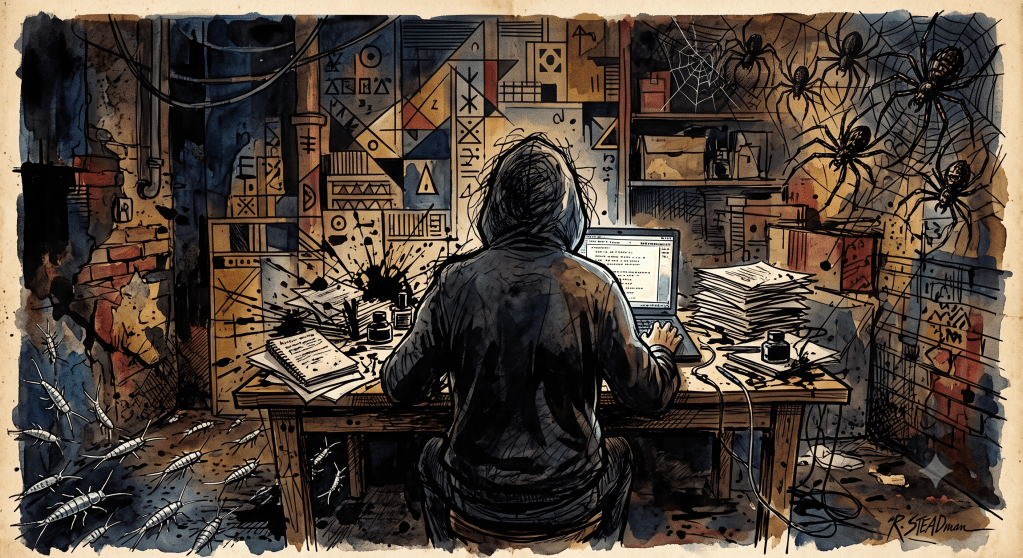
When I picture Yanigahara writing this book, I envision her hunched over a laptop in a damp windowless basement, earwigs and silverfish crawling in the corners of the room, as she thinks to herself: what can I do to make this even more fucked up? She makes us care so deeply about her characters, yet instead of rewarding us for hanging in there through all the dreadfulness with, God forbid, a sliver of hope, she serves up Hamlet-levels of evisceration by killing off pretty much every meaningful character except for a couple, and in the most devastating ways possible: suicides, car crashes, heart attacks, stroke-injections, on and on. Was such scorched-Earth decimation necessary? Would the book have been any less quote unquote realistic if she let a little bit of light remain? It’s a fallacy, after all, to believe that sadness and depression are somehow more “real” than happiness and hope; life always ends in death, that’s true, but our inescapable mortality doesn’t mean that the moments of joy that we experienced along the way are somehow less tangible or honest. Just because death is the end doesn’t mean it’s the only thing about life worth ruminating on. When I watch the sun set over the mountains, that experience is just as real as the act of dying, perhaps even more so, because such an instance fills me with all of the possibilities that life presents. Would it have killed Yanigahara (no pun intended) to include a few more beautiful sunsets?
When I watch the sun set over the mountains, that experience is just as real as the act of dying, perhaps even more so, because such an instance fills me with all of the possibilities that life presents. Would it have killed Yanigahara (no pun intended) to include a few more beautiful sunsets?
Yanigahara, of course, can write whatever kind of book she wants. At the end of the day, the characters are hers, and she can lead them to the slaughter if she damn well pleases. But my conflicted feelings about A Little Life got me thinking about why we read fiction at all: is a well-written story justification in itself, ending be damned? Or do we need to feel like we learned a moral, or at least existential, lesson to make it all worthwhile? I don’t think there’s a single right answer, but one of the more obvious measures of a book’s timelessness is its ability to stick in one’s craw long after the final page is turned, and A Little Life, and the characters within, will undoubtedly remain embedded in my psyche for years to come. When I pull this book off the shelf of my modest personal library in the future and stare at that grimacing guy on the cover, the one that leapt out at me at the used book store, my gut will sink as if I’m looking at a former lover on Facebook: here’s a person I spent countless intimate and vulnerable moments with, who coaxed me into letting my guard down, who wooed and bedeviled me, but disemboweled me in the end. That harrowing ending will always be the first thing I think about when I see this lover, of course, but somewhere in the back of my mind, I’ll also be reliving all the visceral highs we experienced along the way; there will be a bittersweetness there, a chasm between the ways I hoped things would turn out and the way they actually did.
At the end of the day, the fact that I felt compelled to spend nearly 3,000 words alternately praising and complaining about a book that was written more than a decade ago has to mean something, though I couldn’t possibly say what. A Little Life is by-far the longest novel I’ve ever finished, and it yanked me out of my book funk like a car jacker on a sketchy city street at midnight. For that, I guess I owe Yanigahara a debt of gratitude. She may have beaten the hell out of me, emotionally speaking, but damn if she didn’t make me feel alive while bludgeoning me with language; perhaps I’m the precise kind of masochist she had in mind while she was holed up in her musty basement writing this brutal piece of literature.
Now, if you’ll excuse me, I’m going to take a bath to soothe my bruises and evulsions, but I’m not going to read tonight, because I need time to emotionally recover before jumping into another long-term relationship. Maybe I’ll just stick with my generic middle-age dad articles for awhile…they’re much safer, and, generally speaking, don’t force me to imagine horrendous scenes of pedophilia. But they also don’t make me feel as strongly – good or bad, happy or sad – as a great work of fiction does, and despite all my moaning and flip-flopping, maybe A Little Life is precisely that, at least for those of us who don’t mind having our guts torn out and strewn all over the bathroom floor while our five-year-old doses off in the next room over.


Leave a Reply