I’m not entirely convinced that Annie Dillard actually existed in this world. I mean, she had to, in some sense, because she wrote books, great books that you could hold in your hand and read and go wow, I wish I could write like that; but she seemed more ghostly than most. Her hard-won prose, while often grounded in the natural world, felt beamed in from the foggy etherea of the cosmos, where God was hazy and indefinable yet uniformly present. When I think of other authors I admire – David Foster Wallace and George Saunders, to name two – I picture them speaking into a camera, uttering some wise thing about the nature of writing or life. I see no face when I think of Dillard. I picture the books of hers that I’ve read, the ones that entered my life at pivotal junctures and changed the way I understand the inner workings of an indifferent universe. I reckon this is the way that Dillard, and probably most writers, would prefer to be remembered: by their efforts, not their mugs.
Dillard died earlier this month at 81, apparently of natural causes, which seems dubious – though aren’t all causes natural at their core? She purportedly suffered health issues for years, though those issues, like her writing, were cloudy and hard to define. The New York Times sent the death announcement to my phone via push notification in the middle of an otherwise mundane Tuesday, and it felt like a close friend had died, or perhaps a beloved, estranged aunt whose radical approach to life I’ve long tried to emulate, mostly unsuccessfully. I’ve always felt a kinship with Dillard on a geographical level: she grew up in Pittsburgh (my parents were raised 30 minutes north of the city), and her most revered book, Pilgrim at Tinker Creek, is set in the Blue Ridge Mountains, where I’ve lived for the better part of a decade. Those regional commonalities made me feel spiritually closer to her than perhaps any other writer; she was, after all, meditating on places that I know and love. When she reflects on the beauty of the Appalachians in Pilgrim: theirs is one simple mystery of creation from nothing, of matter itself, anything at all, the given, I know exactly what she’s talking about, because I experience that same mystery every day.
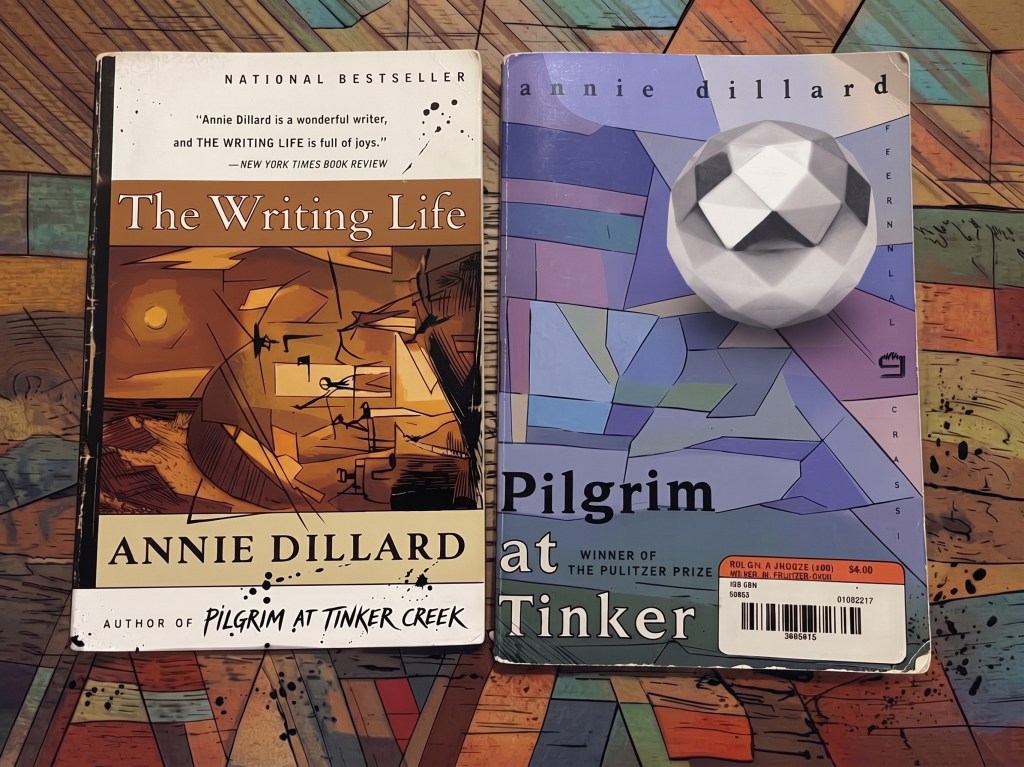
I was introduced to Dillard during a creative writing class in college. We were tasked with reading A Writing Life, a slim-but-dense work that operates as a Tao Te Ching for the literary-minded, or a spiritual sherpa for summiting your personal writing Everest. That book cracked open my mind at a time in my life when my mind, like a pressurized knuckle, was begging to be cracked. It was the first time it’d occurred to me that someone could actually make a life, not just a living, out of being a writer. I know this sounds obvious, but it wasn’t for me: I’d grown up in a blue-collar, decidedly non-literary home, and the idea that someone could just write about whatever was on their mind – not even write a novel, per se, but just…write – and have that be enough wasn’t something that had ever dawned on me. A Writing Life, then, was part sunrise, part blueprint for how I could make such a life possible, in my own imitative little way; she was showing me a fascinating new means for existing in the world.
That book cracked open my mind at a time in my life when my mind, like a pressurized knuckle, was begging to be cracked. It was the first time it’d occurred to me that someone could actually make a life, not just a living, out of being a writer.
Although maybe 60-percent of A Writing Life was totally incomprehensible to me at the time – I wasn’t a seasoned enough reader, writer, or human to fully grasp Dillard’s unencumbered musings – I was awestruck by the way her words flowed like a creek from sentence-to-sentence, paragraph-to-paragraph, page-to-page. It was like she knew a universal secret that she was desperately trying to share with me, a secret I couldn’t quite understand but would spend the rest of my life trying to apprehend, to varying degrees of success. Like here, where she waxes poetic about what lesser artists might have considered an insignificant larva:
Every inchworm I have seen was stuck in long grasses. The wretched inchworm hangs from the side of a grassblade and throws its head around side to side, seeming to wail What! No further? Its back pair of nubby feet clasps the grass stem; its front three pairs of nubs rear back and flail in the air, apparently searching for footing. What! No further? What? It searches everywhere in the wide world for the rest of the grass, which is right under its nose.
Could I ever write like that, so effortlessly about Everything and Nothing? This is what I wanted to know, what I still want to know, what I may never find out. Yet following Dillard’s trail has gotten me closer, if only in my mind. I could spend the rest of this essay quoting excerpts from The Writing Life, because it’s that good, but this would be a waste of time; you could just read the thing yourself, after all, which you should. It’s probably the most personally formative of Dillard’s books, but my favorite is Pilgrim at Tinker Creek . No surprise there: a lot of people love it, and it won a Pulitzer on account of its objective greatness. I first devoured it during a road trip through the American West back in 2018, and once again, Dillard performed her parlor trick of cracking my cloistered mind like a knuckle. It’s a dense, difficult, thrilling, euphoric, and terrifying read, and I highlighted damn near every other sentence because it was so pregnant with unconventional insights and profound quotes, like:
…a lone aphid, without a partner, breeding unmolested for one year, would produce so many living aphids that, although they are only a tenth of an inch long, together they would extend into space twenty-five hundred light years.
Or:
I have hatched, too, with millions of my kind, into a milky way that spreads from an unknown shore.
Who writes about this kind of stuff, and who does it like this – and as a 28-year-old, to boot? It’s astonishing, really: Pilgrim found me at a moment when I was drifting through life as a pure nerve ending, absorbing stimuli and open to the wonder and horror of a world that I was beginning to see as too vast and dynamic to ever fully comprehend. Dillard, then, was my guide to this incomprehension: she was wise company as I laid in the back of my Prius in bone-cold Yellowstone, in a tent on the outskirts of Santa Fe, in a camper van in Monterey, and she showed me how I could – or should – be thinking about this strange life that we’ve all been hatched into: that is to say, deeply, clearly, and unforgivingly.
Dillard has continued to be a guide, nearly two decades after I discovered her. Every time I write, particularly but not exclusively about nature, I can feel her rugged and whimsical spirit floating under my skin. What Dillard has taught me more than anything else (other than, maybe, the importance of rewriting and rewriting) is that you can write about literally anything and do it well, so long as you pay attention. The paying attention is the point, and the writing (and the rewriting and the rewriting) is a means for distilling the sense of attention paid. Dillard implicitly argued via her work that you must pay radical attention to the good and the bad, the beautiful and the profane, if you desire to grasp the world in its rawest and most honest form. This is something that she did so well: articulating the divinity and the horror of existence with X-acto precision, and allowing those two poles to live next to one another in a tense symbiosis.
Dillard implicitly argued via her work that you must pay radical attention to the good and the bad, the beautiful and the profane, if you desire to grasp the world in its rawest and most honest form. This is something that she did so well: articulating the divinity and the horror of existence with X-acto precision, and allowing those two poles to live next to one another in a tense symbiosis.
She used writing as a tool of discovery, or as she put it in the first sentence of A Writing Life: a miner’s pick, a wood carver’s gouge, a surgeon’s probe. She was, by turns, prickly and gentle, but always, always, intense. She would’ve made a great monk, if only she could’ve laid off her beloved Vantage cigarettes; otherwise she was quite monk-like, dedicated as she was to her craft, so clear-eyed about suffering. She wrote like the world might end before she finished her next word, which, of course, is true, and also the only way to write. She tap-danced to her own cosmic rhythm, and she will continue to live under my skin, more ghost than not, burned into infinity like she knew she ultimately would be. Or as she put it in near the end of Pilgrim: You see the creatures die, and you know you will die. And one day it occurs to you that you must not need life. Obviously. And then you’re gone. Rest in peace, Annie Dillard. You were a real one.


Leave a Reply