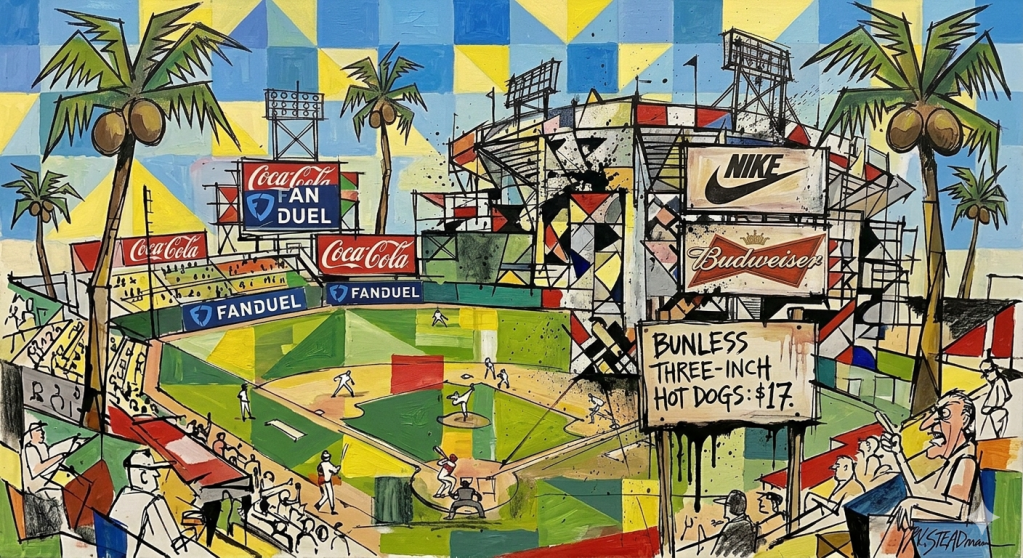
Each March, I crawl out of winter, bleary-eyed and disoriented, like someone who’s been held captive in a cave for decades and can’t remember how to navigate the world. The first thing I see when I drag my pale, sluggish body towards the warmth are men swinging bats and throwing balls in Arizona and Florida. Initially it feels like a mirage, like my exhausted mind is deploying a coping mechanism for the bitter cold that I’m sure, this time, will last forever. Yet these men keep showing up, day-after-day, on diamond-shaped fields flanked by sun-drenched pastures, and they’re wearing colorful uniforms, and they’re smiling, and their faces look familiar, like I’ve known them in some Edenic past life. It’s only after about a week of watching these men gather and play that I concede that what I’m seeing is real, that I can let down my guard and trust my senses, that the perverted Cavemaster isn’t going to drag me back into his frigid lair for another round of lashings. The tilt of the Earth is aligning itself the way it does every year; it’s spring, it’s baseball season, and for a certain subset of people, it feels like life is beginning again.
I’ve tried to hash out my curiously enduring love of baseball many times in the past, but it feels like I haven’t gotten to the heart of it, that I’m either repeating myself or burrowing towards a center that doesn’t actually exist. Words struggle to articulate why I feel compelled to care so deeply about a slow-paced game played by men-children. At the professional level, baseball is just as money-grubbing and profit-driven as any other major sport, perhaps even more so (re: no salary cap), yet I attribute an innocence to it that I unfairly refuse to extend to other sports. Why? There’s the nostalgia aspect, of course: I grew up playing it, I grew up watching it, and my relationship to it was forged when I was full of wonder and utterly blind to its rapacious underbelly. Maybe my ongoing love of the game is simply a practice in willful ignorance, a stubborn warping of the facts to make them fit my convenient little delusions. My head knows there’s nothing pure in this world, yet I can’t deny how the sport makes me feel in my marrow: every spring, my chest fills with the brilliance of infinite possibilities, and I am once again the little boy that still lives inside of me, the polyanna who hasn’t yet been burdened by the realities of a for-profit world.
Maybe I’m projecting the raw innocence of this subjective feeling onto an undeserving capitalistic enterprise, convincing myself, in some half-understood way, that if baseball feels so good and true to me, then it couldn’t possibly be wrong. Maybe the purity I see in the eyes of players like Pete Crow-Armstrong and Nico Hoerner (two guys that, to me, embody the untainted heart of the sport) is an example of me simply seeing what I want to see; but even if this is true, I’m still seeing it, aren’t I? It’s like Adam Gopnik put it in a recent piece for The New Yorker: “Aesthetes distill pure pleasures from what could be seen, from other angles, as compromised messes…Can our love for our contemporary teams escape our knowledge of their brutal base?…In truth, the larger story of modernity is always the story of how money-seeking enterprises become heart-warming attachments. Capitalism devours our affections as it creates them.” The Chicago Cubs might be just another money-grubbing sports franchise, but they’re my money-grubbing sports franchise, damn it.
The Chicago Cubs might be just another money-grubbing sports franchise, but they’re my money-grubbing sports franchise, damn it.
There’s nothing befouled, of course, about baseball on the amateur level, which is something my wife, son, and I have become active participants in. We’re a glorified baseball family, and my wife, decidedly not a sports fan, still doesn’t quite understand how or why it happened. She doesn’t want to become those parents, you know the ones I’m talking about: the mom and dad who wear their kid’s jersey in the bleachers, yell louder than everyone else, and potentially insult the teenage umpire; yet I fear we’re on our way down this shameless road. Saturdays are for our five-year-old’s tee-ball games, Sundays are for my 35-plus baseball games (for which my son is a bat boy), and every day is for watching the Cubs, and for having our son ask, ad nauseum, to go to the field to practice his swing. His mind is all baseball, all the time, which makes sense, considering I’ve been indoctrinating him with Cubs propaganda since he turned two. He woke up with a fever a few days ago, and the first thing he asked, at 4:30 in the morning, with his forehead hot as a wood stove, was does this mean I’ll never get to play baseball again? I assured him that his sickness wasn’t terminal, that he’d be back on the diamond before he knew it. In the meantime, we could snuggle on the recliner and watch our favorite money-grubbing sports franchise play a low-stakes game in April.
The promise of spring, with its mild days and signifiers of positive change, gives way to the muggy slog of summer. The novel becomes the everyday. Baseball, like the one season it inhabits from beginning to end, solidifies into hot cement covered in peanut shells, and in doing so becomes less a sign of rebirth and more a grind to be endured. One hundred and sixty two games across the six hottest months of the year, and that’s just the regular season. It’s been said that baseball’s interminable parade of games, which features twice as many contests as any other major American sport, is to its detriment, because the importance of a single game is significantly diluted when it’s a mere drop in a river. Yet there’s virtue in the absurd incessantness of baseball’s calendar: it weeds out the phonies, the surface-level supporters, and allows its most dedicated adherents to form what feels like a more substantial connection to the players they see on TV. When you wake up every day knowing you’re going to watch the game, whether you want to or not (and some days, you do not) baseball fandom becomes not a practice in pleasure but endurance; you suffer alongside the players, through the blown leads and the devastating losses and the lethargic blowouts and the cold April games with 3,000 people in the stands and the hours-long rain-delays in August and the late-innings pitching changes, knowing that when the triumphs come (and they will, eventually, come) they’ll taste all the sweeter. After all, look at the trouble you had to undergo just to get there.
When you wake up every day knowing you’re going to watch the game, whether you want to or not (and some days, you do not) baseball fandom becomes not a practice in pleasure but endurance; you suffer alongside the players, through the blown leads and the devastating losses and the lethargic blowouts and the cold April games with 3,000 people in the stands and the hours-long rain-delays in August and the late-innings pitching changes, knowing that when the triumphs come (and they will, eventually, come) they’ll taste all the sweeter. After all, look at the trouble you had to undergo just to get there.
Baseball, like life, is heavy on suffering, and it’s only after we learn to accept this suffering as inevitable that we begin to appreciate the rare moments of beauty that vindicate the tedium and heartbreak that preceded it. Here’s Gopnik again, from his New Yorker article: “Perhaps the missing, under-celebrated figure in these reflections is the nonfan, the necessary nonparticipant, the invisible planet tugging at the orbit of the rest of us. The long-puzzled partner wanders in as the extra innings of a World Series game drag past midnight and hears you say that you will come to bed when it is finally over. ‘Well, enjoy it,’ the nonfan says cheerily. ‘You do not enjoy a game like this,’ the fan mutters. ‘Well, then, do…whatever you do with it,’ she says. And you do.”
Yes, you do; I do. And why? Because in baseball, if you wait long enough, if you possess the mental and spiritual fortitude, or perhaps the thinly-veiled stubbornness, to simply be present, day-after-day, outcomes be damned, then you’ll occasionally be rewarded with moments so pregnant with magic that they’ll wash away the plaque that’s collected on your hardened soul. For a bright and fleeting moment, you’ll feel like an astonished seven-year-old again; you’ll momentarily become blind to the fact that the men-children on the field are depressingly overpaid, that you have to wake up at 6:30 tomorrow morning to go to work, that you’re merely a middle-class cog in a heartless machine that must continue churning to pay the mortgage and buy the groceries, and you will experience…joy. Pure, stupid little child-like joy, totally divorced from the grim realities of the for-profit world, even as the sport you adore is the culmination of for-profit preposterousness.
A contradiction? Sure. A delusion, too, but a beautiful one; we all need the comfort of small delusions to soften the thrashings of modern life, to make it all a little more bearable, to pleasantly distort the unsightly Truth we know is lurking underneath. Baseball is a game that always finds a way to surprise me, to redeem itself, just when I think I might be ready to write if as too boring, too compromised, too profit-driven; I endure, endure, endure, and every now and again, I rejoice, and the rejoicing feels so good that I mostly forget about the enduring – and, momentarily, the money.
 Ourland
Leave a comment