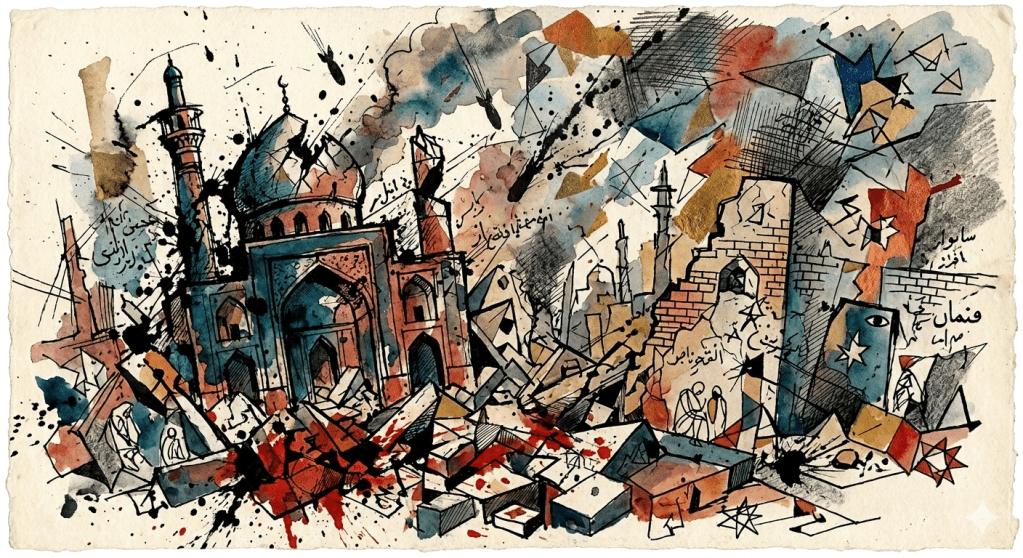
There’s a war on in Iran, and so many other reasons to worry about the national and international order, but I try to forget about all that when we fly down to St. Pete, as we do every March with the dependability of migratory birds. There will be plenty of time, when I return to Virginia, for listening to Ezra Klein and Ross Douthat, for reading articles about the climbing death toll in the Middle East and the rising cost of living here in the states. But I put a pause on all that while we’re in Florida, because what good is a vacation if you don’t mentally extract yourself from the exhausting vortex of media fatalism? This incredible privilege – having the option to ignore the news – isn’t lost on me; bombs are falling all over creation, innocents are dying, and here I am moping because I merely have to hear about it. It’s so easy for us Americans to forget how good we have it, isolated as we are from the world’s more violent and generationally-entrenched problems. We can turn off our televisions or put down our smart phones and pretend nothing awful is happening. We could go for a very long time without even thinking about war; there are no bombs falling in our backyards, after all.
Nor is there any violence in my insulated Florida bubble, except for the occasional seabird gobbling up helpless fish. I’ve been taking a dip in the gulf each morning, or at least the mornings when it’s warm enough to do so, because despite its reputation, Florida actually does get cold, or at least coldish. We’re staying at a yacht club in Madeira Beach, right across the main drag from the Gulf of Mexico; I slip out the door just after sunrise, and with a hangnail moon pasted on the blue-black sky, stroll past rich people’s boats and seagulls perched atop wooden posts jutting out of the water like oversized peg legs. I pass a boarded-up Winn Dixie and a SMOKE SHOP and an outdoor bar called the Saltwater Hippie, which is right next to a sign that reads “MAD BEACH STRONG, WE GOT THIS, HURRICANE HELENE, Sept. 26, 2024.” A few shops in this strip still have boarded-up windows: one is the TRUMP STORE, which announces its presence with bold white lettering on a blood-red sign (how else?). From my balcony overlooking Boca Ciega Bay, I can see a LET’S GO BRANDON flag flapping in the wind, and right below it, several more roped in lockstep to a chainlink fence.
There’s hardly anyone on the beach so early in the morning, save the occasional retired couple strolling whimsically like they’ve realized all their dreams and the only thing left to do is croak. On its best days, the gulf is as calm as a bathtub, which means I’m able to go belly-up like a rotting fish, letting the rich blue sky saturate my field of vision and the saltwater fill my ears with the pleasant drone of nothingness. I float there and pretend the world isn’t spinning, that time isn’t moving forward, that all of us marooned souls aren’t pressing onward towards – what? I sink and bob, sink and bob, as the air sacs in my chest fill and deplete, until a wave floods my face, spilling salt water into my eyes and into my dry nostrils. The early morning beach spell is broken: it’s time to wander back to the yacht club, nodding at the pelicans as I pass, a damp beach towel slung over my shoulder, my thighs numb from the bitter wind. I look forward to cosplaying as a rich person for a few more days.
No matter how laid back I try to keep things down here, the seriousness of the outside world always finds a way in, sometimes subtly, other times like a wave crashing over my sunburnt face: gas prices have been running a fever at four dollars per gallon; a novelty shop at John’s Pass proudly sells Gulf of America tank tops and Alligator Alcatraz t-shirts. Even the usually benign world of sport hasn’t been immune from geopolitical creep: the championship game of the World Baseball Classic was between Venezuela and the United States, which was significant for obvious reasons. For his part, Venezuela’s manager, Omar Lopez, wisely chose to focus on the game instead of the fraught politics surrounding it. Sports, as other people have wisely noted, are like candy: empty calories, consumed purely for pleasure. This is true even at the international level, where the stakes seem higher even though there are, truly, no stakes at all. The trouble comes when people start treating sports like meat and potatoes; such a severe inversion of the food pyramid isn’t sustainable. Venezuela won the game, by the way, and unexpectedly so. There were tears of joy, flags draped over players shoulders, proclamations of national pride, but no mention, at least that I heard, of Maduro or Trump. This is exactly the way it should’ve been, or at least the way I selfishly prefer it.
It’s human nature to rebuild, to try again and again, even if the long-term, or even medium-term, prospects are tepid at best. Whether this is folly, resilience, or both, is unclear; perhaps it’s something else entirely.
Then there are the stark reminders of climate disaster right outside our door at the yacht club: Madeira Beach was underwater after Hurricanes Helene and Milton two years ago, and the recovery is ongoing. Many of the first floor condos are still in various stages of disrepair. Yesterday a circular saw was humming outside the bottom unit next door, which was stuffed with large cardboard boxes. A few buildings down, cement blocks have been knocked out of the bottom of a Florida room like busted teeth. There are work trailers pulled sideways in the parking lot, tanned men ambling about with drills, fixing things I’d have no idea how to fix. It all seems so futile, knowing it’s only a matter of time – five years, ten years, twenty? – before another significant storm turns this island into a glorified pond. Yet it’s human nature to rebuild, to try again and again, even if the long-term, or even medium-term, prospects are tepid at best. Whether this is folly, resilience, or both, is unclear; perhaps it’s something else entirely.
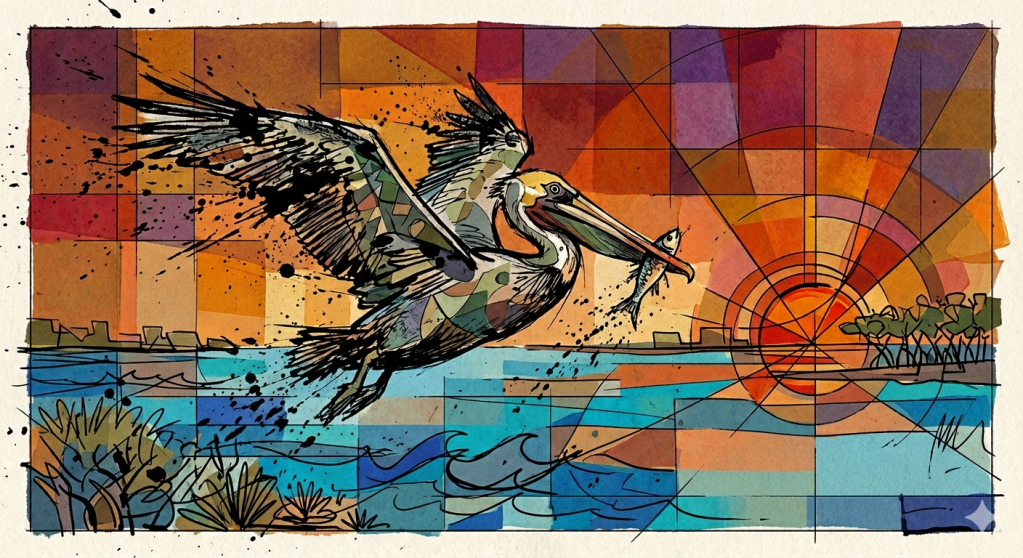
Yet it’s totally understandable why people still want to live at the beach, will always want to live at the beach, inevitable destruction notwithstanding. Something about the salty air and the sunset glow and the soaring seabirds does a body and soul very good, indeed. My five-year-old son and I have been sitting on the balcony at least once per day to watch pelicans float on the breeze and, occasionally, dive like fearless kamikazes into the bay to scoop up fish. I told him that, if you looked at the water long enough, you might just see a fish leap out; I’d seen it happen twice since we’d been here. He paused for a second, and because five-year-olds always ask the unexpected question, said: what do the fish say? I told him that, really, it depended on the fish, but most of the time they’re just popping up to tell us their name, like hi, my name is Jim! My son found this hysterical in a way that only someone who doesn’t have to worry about paying a mortgage can.
Later that day, while I was punishing my dumb little body with an afternoon jog along the docks, admiring rich people’s assets, I saw a family of four flip-flopping toward me on the sidewalk. I cut through a patch of grass to avoid them, and felt my heart drop when I wound up eye-to-eye with a pelican. It was a foot away, at most, with the back half of a pretty substantial fish flopping stupidly from its beak. Pelicans are enormous birds, if you didn’t know, one of the more obvious descendants of dinosaurs; truly a modern-day pterodactyl. The big bastard waddled backwards a few steps then took flight, its substantial wings whooshing as it achieved lift-off. I whispered goodbye to poor Jim, who was still dangling from the prehistoric creature’s beak as it sailed across the bay, toward the LET’S GO BRANDON FLAGS and the steady hum of fossil fuel-powered vehicles on the 150th Avenue bridge. Hard times at the yacht club, for real; but it beats hard times pretty much anywhere else in the world.
 Ourland
Leave a comment