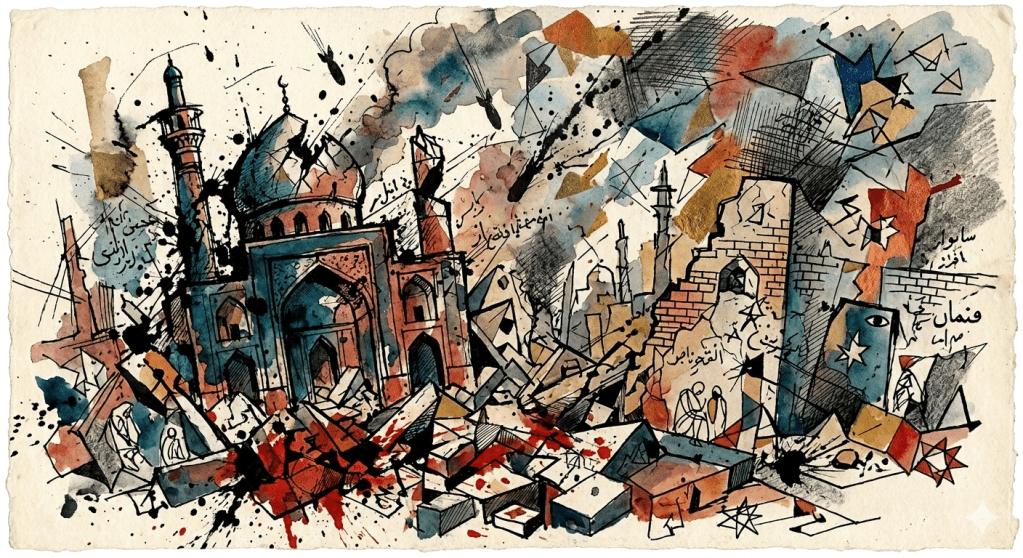
War is terrible, and unfortunately we have another one on our hands; in the Middle East, of all places, where we don’t exactly have a sparkling track record. Congress didn’t approve it (they weren’t even asked about it), and the American people are overwhelmingly against it, yet here we are, waking up each morning to more videos of explosions and decimation. And to what end? Few would argue that Ali Khamenei wasn’t a ruthless despot deserving of his fate, considering his regime has murdered thousands of protestors over the past several months. His death has been celebrated worldwide, and for good reason, but what comes next? It seems reckless for the U.S. to pummel a country with airstrikes, kill its leader, then say, as Trump did in his first public statement about the attacks: alright, we did our job. You guys can figure it out from here. Trump, perhaps emboldened by his relatively frictionless capture of Nicolas Maduro, seems to think that killing the bad guy was the end game, when of course it’s only the beginning. It’s nearly always only the beginning.
The thing about war, even one as newborn as this, is that it distorts atrocities. The melee of bombs dropped in the initial attack of Operation Epic Fury (which sounds more like an energy drink than a military offensive) killed Khamenei, and he won’t be missed, but that same strike also slaughtered at least 150 people at a girls school in Minab. This tragedy made headlines, sure, but almost as an afterthought, as if its horrendousness was somehow blunted by the fact that it took place within the context of war. Imagine how extensive the news coverage would be if a gunman walked into a school in, I don’t know, Pittsburgh, and murdered 150 people. CNN and Fox News would be reporting on it for days, maybe even weeks; there would be thoughts, prayers, memorials, candlelight vigils. Does it matter that the Iranian school disaster occurred within the framework of a conflict? That it was an accident? That the same airstrike eliminated a brutal autocrat? I’d argue no, on all fronts, because the death of one, or even a few, bad guys doesn’t excuse the haphazard killings of scores of innocent civilians. Yet the dark glow of war falsely blunts the edges of otherwise unthinkable catastrophes. Dead children should never be met with a shrug, or a deflection, especially from the men who ordered the bombs to be dropped in the first place.
The dark glow of war falsely blunts the edges of otherwise unthinkable catastrophes. Dead children should never be met with a shrug, or a deflection, especially from the men who ordered the bombs to be dropped in the first place.
I tend to fall into the Kurt Vonnegut camp when it comes to war: it’s awful even when it’s necessary, doubly so when it’s unnecessary. Does anyone really believe that it was crucial for us to attack Iran right now? That our fundamental way of life was at risk? I thought we’d “completely and fully obliterated” Iran’s nuclear capabilities back in June, and that it would take years to rebuild their program, as the Trump administration claimed. If that was true, then what was the emergency? It wasn’t true, of course, and Trump’s decision to attack this time, which appears to have been heavily influenced by Israel, has kicked over the first domino in a run the end of which we can’t yet see. If that run ends up being longer than anyone expected, it won’t be Trump or Vance or Hegseth or Rubio who suffers, but the civilians mired in the violence, and the young people on both sides who will die for reasons that they, or anyone else, can barely understand. As Vonnegut put it in Slaughterhouse Five: “we’ve had to imagine war here, and we have imagined that it was being fought by aging men like ourselves. We had forgotten that wars were fought by babies. When I saw those freshly shaved faces, it was a shock. ‘My God, my God,’ I said to myself. ‘It’s the Children’s Crusade.’”
So it goes. Here we wait, in the early innings of a dangerous ballgame. Hundreds of innocent people are already dead. Six American service members have been killed. Oil prices are up and the stock market’s down, not that these two things matter all that much in the shadow of widespread death. What’s left of the Iranian leadership is thrashing and flailing, bombing numerous adversaries in its orbit and risking a severe escalation of a war that already seems to be spinning out of control. Trump, the self-proclaimed peace candidate, the guy who’s practically been begging for a Nobel Prize, has said that many more American lives may be lost, and that he has no qualms about extending this conflict as long as necessary to achieve his objectives, whatever those objectives actually are (Decimation of the nuclear program, again? Regime change? American protectionism? All of these? None?). It’s frighteningly easy to envision this offensive becoming another dismally protracted engagement in a part of the world where we have a history of dismally protracted engagements. Yet it’s early enough to envision an off ramp that keeps the United States from being driven deeper into the kind of aimless war that Trump promised to avoid, the kind of war that continuously distorts the deaths of innocent people to the point of numbness. Trump makes a lot of promises that never amount to much; the best we can hope for is some kind of diplomatic solution before the momentum of the tumbling dominoes grows too overwhelming to stop, flattening the young and the innocent as it goes.
 Ourland
Leave a comment