
This article originally appeared in the Augusta Free Press.
“These are our few live seasons. Let us live them as purely as we can, in the present.” – Annie Dillard, Pilgrim at Tinker Creek
Anytime I feel the walls of domestic life closing in a little too tightly, I head for the river shack in Hinton. I shouldn’t say every time: I’ve only stayed there twice, with the most recent visit being for one night in July, but those two trips solidified the idea that Hinton is the exact place I need to be when my soul feels smothered by the demands of contemporary existence. There are many things I love about being a husband and father, indeed, fulfilling those roles has given my life a greater sense of purpose than I ever thought possible, but sometimes a hard reset is in order, and when that time comes, there’s no better place to go than into the throbbing green heart of nature: to wild and wonderful West Virginia.
Hinton is about two-and-a-half hours from Staunton: after a quick jaunt up 81 and 64, then another 20 minutes on winding Route 20, you’re there. It’s the biggest town (population: 2,200) in Summers County (population 11,500), which has virtually no industry and is one of the best places in West Virginia to experience unfettered natural beauty. The state’s motto is “Almost Heaven,” and it’s easy to imagine whoever devised that slogan thinking precisely of the deep river valley in Hinton, where the fat water flows, by turns and depending on rainfall, lazily and chaotically, serenely and violently. The town of Hinton itself, a National Historic District (a faded ad on the side of an old brick building reads: “Drink Coca Cola! Delicious! Refreshing! Relieves fatigue! Sold everywhere!”) is quaint, welcoming, and thoroughly West Virginian. The thing that has drawn me to this place like a mosquito to flesh is the way it feels cleaved off from modern society, both in how the town seamlessly melds itself with nature, and also because, like many places in West Virginia, it seems so damn remote. The state’s biggest city is Charleston, which is hardly a metropolis, and anyway, it’s 90 miles northwest of Hinton. It’s not hard to imagine someone beaching a kayak at the base of one of the mountains along the New River and walking headlong into the overgrown wilderness, never to be seen again. Point being, Hinton is out there.
The river’s the thing in Hinton, which is why I go full-on primitive when I visit, choosing to sleep in a dilapidated shack right on the water. There are five structures on the property: a vacant single-family home, an enormous two-story house on stilts (where the host lives), a partially-finished garage apartment, a janky garage, and the infamous river shack. The shack wasn’t cleaned or even swept either time I stayed there. During my most recent visit, Busch Light cans were strewn about the yard like giant grains of silver sand, and a shotgun was leaning ominously against the fire pit. But for $40 a night, I don’t much care, so long as the shotgun’s not pointed at me. In the shack, there are two novelty cans of “roadkill soup,” one called “skunk a la king,” sitting on a table. A large painting of a yellow orb weaver hangs on the plywood wall, and an uncommonly comfy cot is shoved haphazardly into a corner. There’s a whimsical painting on the cabinet of a man carrying a knapsack: he’s reached a fork in the road, one direction reading “your life,” the other “no longer an option.”
The space has a window AC unit that looks like a first-generation product from the 1930s. Thus, my beloved river shack exists in a liminal space between camping and glamping; it ain’t bougie, but it beats the hell out of sleeping on an air mattress in a non-temperature-controlled tent. I like to rough it, but in a pampered sort of way. I even have access to an (uncleaned) shower, (half-cleaned) toilet, and a partial kitchen, located in the half-finished two-story garage apartment, which this time was tastefully decorated with four empty Mike’s Hard Lemonade cans by the sink and a shredded Busch Light case tossed into the corner of the room, next to an overflowing litter box. I ascended the steps to see what was in the loft area and found a twin mattress jammed against the wall with an additional five cans of Mike’s Hard built up like a cairn next to it. There was also some kind of semi-automatic weapon casually lying on the floor. The host told me her “buddy” had slept on the property the previous night; I can say with certainty that this buddy of hers knows how to party.
From this vantage point, I can follow the flow for maybe half-a-mile, before it disappears around the bend, pushing onward through the deep, green river valley. It will eventually blend into the Kanawha, then the Ohio, then the Mississippi, then finally out into the Gulf of Mexico. Although I only get to witness a small portion of this journey, I’m fortunate to have seen it at all. I wish the water well as it snakes its way through the hills and out of sight.
All of this sketchiness is worth it because the shack is right on the water. I’m able to take one of the rusty fold-up chairs the host has left lying in the tall grass down to a small dock that’s caked in mud from previous high-water events, and just sit and watch the river go by. From this vantage point, I can follow the flow for maybe half-a-mile, before it disappears around the bend, pushing onward through the deep, green river valley. It will eventually blend into the Kanawha, then the Ohio, then the Mississippi, then finally out into the Gulf of Mexico. Although I only get to witness a small portion of this journey, I’m fortunate to have seen it at all. I wish the water well as it snakes its way through the hills and out of sight. “It has always been a happy thought to me that the creek runs on all night, new every minute,” Annie Dillard wrote in her seminal work Pilgrim at Tinker Creek. “Whether I wish it or know it or care, as a closed book on a shelf continues to whisper to itself its own inexhaustible tale.”
I’d forgotten what it was like to swim. I mean, actually swim: that it was possible to go past where you can touch and keep paddling, knowing there’s nothing to stand on should you lose steam. I did this at Sandstone Falls, which at 155-feet across, is the largest waterfall on the 320-mile-long New River. To get there, you drive along New River Road, a scenic stretch of asphalt that hugs the shore like a snakeskin, before venturing onto the well-maintained boardwalk, past the great rushing falls, and into what feels like an exotic island rain forest in the middle of the river. I leapt, rock-to-rock, around the perimeter of the island until I reached an isolated spot with calm water that I could wade into like some kind of human inner tube. I felt protected by the fuzzy green mountains rising from the water’s edge like friendly elders.
There was a small grassy island in the middle of the river with a platform of large, smooth rocks. It didn’t seem too far out there, and looked like a nice place to sunbathe, so I backstroked toward it. It didn’t take long for the mental safety net of the river bottom to be yanked from under me: when I stretched my legs below me and found zilch, I flew into a mild panic, hanging there as I was above the void. I quelled this anxiety by recalling something someone once told me about my fear of heights: the physical act of walking or climbing is no different whether you’re a foot off the ground or 500 feet in the air. The mechanics don’t change: just calm your mind and do the thing. Swimming, I guess, is the same; no matter the depth of the water, all you have to do is paddle, one sweep of the arm at a time, and you’ll be fine.
It didn’t take long for me to figure out I wasn’t going to reach the little island. What once appeared so close seemed to move further away as I paddled toward it. The river’s flow intensified, and I noticed myself being pulled downstream much quicker than I was comfortable with. I looked out at the island and thought: I could probably still make it, but is it worth it? I’m a father and a husband now, and if I drowned trying to swim out there, for no reason other than to do it, I’d curse myself as a dumb and selfish fool as I sank to the murky bottom like a Darwin Award-winner. I didn’t want to go the way of Jeff Buckley, so I reversed course and backpaddled to shore, urgently flapping my arms to pull myself out of the river’s swift(ish) grip. Rocks eventually returned underfoot. I slipped and slid across them, stepping carefully so I didn’t snap an ankle, before finding a warm, mud-caked boulder to flop my wet body on top of. I sat in the heat, huffing and puffing, water dripping off the ends of my hair, the summer sun drying my skin, as a small gaggle of geese floated lazily down to the little island and set up shop, as if reaching it required no effort whatsoever, which for them, I guess it didn’t.
I wanted to get a closer look at the actual falls, which from the boardwalk were, at their closest, maybe 50 feet away. They were impressive from a distance, but I wanted a more intimate experience, to feel the full extent of their raw power. I noticed a shirtless man who looked like he’d been baking in a tandoori oven for weeks fishing in shallow water a couple hundred feet from shore. I figured moving toward him would be my best access point, so I shimmied through a marshy area and onto the shallow rock shelf that stretched far out into the river. The rocks were much less slick than expected, and the water never deepened past my shins, allowing me to push closer to the thundering falls. The violent rush of the rapids grew louder as I hopped, on shaky knees, over hot little pools of algae and human grime.
By the time I reached the boulders, the whoosh of the falls was so thunderous it filled my ears like wax. I climbed down the enormous boulders, carefully and deliberately, eventually posting up on the least jagged one, kicking my legs out about 10 feet above the livid white water. The froth and foam were pouring in from boulders over 15 feet high, crashing down into a cacophonous pool that was swishing and swirling like a gigantic angry toilet. It was invigorating to be so close to all of this chaos, and as I gazed into the semi-transparent waterfall, I noticed what seemed to be a void space back there, inside of which any number of magical creatures could be living. Fairies? Sprites? Old Gregg? Nothing seemed impossible. Sitting there on the smooth boulder, it dawned on me that one wrong move could send me tumbling into the vortex, where I’d be churned to butter…and with no one around to see me slip, I’d stay missing for several days, weeks, or even months, until my waterlogged corpse washed up somewhere in Ohio, far down river.
I’m exaggerating a bit: I was never in real danger of falling into the water. Yet any number of possibilities, even the darkest and most unlikely ones, crossed my mind out there on those massive boulders. For one fleeting and troubling instant, I considered leaping headlong into the roiling pool. To be so close to such extreme hydraulic power was humbling, and perhaps some darkened corner of my psyche wanted to experience the feeling of being whipped to bits, of be pinned down by the powerful hand of Mother Nature and ground into tiny grains of human dust that would float down into the soft mud of a river that, perhaps, resembled the body of water our brainless single-celled relatives once floated around in billions of years ago.
I’m Annie Dillard when I observe nature. What I mean is I feel myself trying to be Annie Dillard, specifically the Dillard from Pilgrim at Tinker Creek, where she, one of the great writers of our time, sets out to crack the divine code of the natural world in the most boring way imaginable, yet the only way you can really do that sort of thing: by simply going into the woods and paying attention. She sat out there day after day, alone in these very Appalachians, observing the sloth-like anti-theatre with an immaculately patient eye. I don’t, and never will, possess Dillard’s talents for writing, observation, or sheer endurance, but still I try, in my imitative little way. After a long day of swimming and watching the falls froth with enormous power, I collapsed in the fold-up chair on the muddy dock by the shack and observed the ancient grandfather river as it rolled through this short section of the valley on its lengthy journey to the gulf.
I assume my Dillard-like nature like a method actor sliding into character: I sit and breathe and try to relax my muscles, while things my mind insists I should be worrying about buzz around in my psyche like actual mosquitoes that buzz around my head. After some effort, or perhaps anti-effort, I feel my dumb body soften, my internal knots untie, the perimeters of my body dissolve. I am coalescing with the natural world, returning to some kind of primitive state like a haunted child back to the womb: the brown river flowing before me, the birds squalling from the trees, the tiny bugs skimming across the water…all of these seemingly disparate entities are part of me, and I of them. I don’t mean to sound like some Buddhist-wannabe who thinks he’s reached enlightenment because he spent one stupid night alone in an air-conditioned shack in someone’s backyard, but I can’t deny I felt a sense of communion out there, a realization that despite humanity’s best efforts to separate ourselves from the natural world, like we’ve somehow grown up and moved out of the house, we are undeniably its children. Maybe this is why our brains release pleasant chemicals every time we draw closer to Earth. Even so, in these moments of full immersion, my contentment usually has a dull ache of emptiness, a vague yearning for some intangible thing that can’t be named.
A few weeks after my river shack trip, back in the pumping heart of society where I was yet again being yanked in 17 directions at once, I read an essay in Harper’s Magazine titled “The Reenchanted World.” The piece startled me in its ability to precisely articulate the hazy brew of happiness and longing I felt along the banks of the New River, and so often feel when alone in nature. The following passage in particular spoke to me:
I could, of course, turn my back on it all and move out to the countryside, into the woods, up into the mountains, or out to the sea, and live a healthy life as a machineless Luddite, close to nature. I had sometimes left everything, lived on distant small islands out at sea, in cabins in the woods and in the mountains, not to get closer to nature, admittedly, but to write, and for no more than a few months at a time. These months were marked by a lack, a constant desire for something that wasn’t there, something that what was there couldn’t fulfill, neither the sea nor the woods nor the mountains. We are connected to one another, we who live now, we who, if fate would have it, pass one another on the street one day or not, we who sit next to one another at a bus station one evening or not. We have lived through the same times, heard the same stories, seen the same news, thought along the same lines, had the same experiences. We are woven into one another’s lives, and in that weave – which is invisible, a bit like how the force field between particles is invisible – is where the meaning is created, also the meaning of nature. It sat in my head. It sat in me.
It’s seven o’clock and the sun is tucking itself behind the mountains. I’m in the shade here, but up around the bend, maybe half-a-mile away, our Father Star is still illuminating part of the river valley. I decide to take another swim, even though earlier in the day, after my ill-fated attempt to reach that small island, I’d read on the National Park Service website that the New River is an impaired waterway, thanks to fecal coliform bacteria contamination (re: cow poop, mostly) during periods of heavy rain. Regular monitoring has revealed trace metals, sediment, and acidic runoff, as well as an “influx of raw sewage” in tributaries of the New River. But wait, that’s not all: the river is also inundated with “unlined landfills, illegal dumps, pesticide sprayed directly [into the water], agricultural runoff (re: more cow poop), road salt runoff, direct discharge of residential sewage, inadequate municipal sewage treatment facilities, recreation waste streams, and industrial discharge.” I understand all of this intellectually. I know that, by wading into the water, I’m essentially bathing in any manner excrement, chemicals, trash juice, and coal residue, yet I throw myself into the questionable brown liquid anyway, because I’m constantly doing things against my better judgment, and also because, in the moment, my desire to commune with nature, albeit tainted nature, usurps my counter desire to remain healthy and clean. I think Dillard would agree that, to truly live, sometimes we must abandon logic and embrace our feral nature. “I won’t have it,” she wrote. “The world is wilder than that in all directions, more dangerous and bitter, more extravagant and bright. We are making hay when we should be making whoopee; we are raising tomatoes when we should be raising Cain, or Lazarus.” I step over a submerged tire and several softened tree trunks that have collected on the riverbed, then flip onto my back as the cool water pricks my skin and fills my ears with a white noise that simultaneously blocks out the world and returns me to it. I sweep my arms and move slowly upstream, accidentally sucking up mucky water through my nostrils. I think: This is it: now I get a brain-eating bacteria and die.

Thoughts of certain death notwithstanding, I’m reminded, once again, of how easy it is to backstroke. I could do this for days. I see the pale underbellies of maple leaves, the asses of birds, white clouds thin as gossamer disintegrating in the powder blue sky. It is peaceful, I am content, and for the first time in forever, I’m not thinking about being somewhere else or doing some other task. I’m not making mental time calculations, I’m not fretting about what I need to do to stay on schedule so I can get home at a reasonable hour and get the kid fed and put to bed at a sensible time, etc etc. I’m merely a human body with no future and no past, alive for now (until the brain-eating bacteria begins their colonization), floating in a ceaselessly animated body of water that was here long before I sprang into existence and will remain here long after my bones are churned to dust. Floating here amidst the inevitable mammalian dung and potentially carcinogenic runoff, I can almost catch a glimpse, in my typical sophomoric way, of what true enlightenment might feel like: that is, total absorption, a dissolution of the boundaries between you and me, this and that, here and there, right and wrong, and all the other constructed dualities that shade our understanding of the world. It’s like Paul Bloom wrote in a recent piece in The New Yorker: “Solitude…gives us a chance to commune with nature, or, if we’re feeling ambitious, to pursue some kind of spiritual transcendence: Christ in the desert, the Buddha beneath the tree, the poet on her solitary walk.” I am Buddha-lite, Diet Christ, a mock poet, a Dillard wannabe. Maybe she would be proud.
Why does it take a one-night vacation in West Virginia for me to slow down and observe the world? I’m just as capable of watching the clouds waft languidly overhead from the comfort of my backyard in Staunton. So why don’t I do it? Is it because I feel, in an almost unconscious way, that living in the moment is a privilege that can only be indulged during brief respites from “real life?” Is it because a part of me would feel embarrassed if a neighbor caught me lying in my backyard on a Tuesday afternoon, like some, God-forbid, unindustrious European? Am I worried about being perceived as lazy, the ultimate sin in our chronically overworked nation? Maybe there are some grains of truth to all of these reasons, but as I’ve grown older, I’ve learned to care less about what other people think, though as a biologically social creature, I undoubtedly still care, and always will care, no matter how much I say I don’t, no matter matter how much I wish I didn’t.
I think the more accurate explanation is that I, like all of us, operate within the expectations of our ingrained society, and our minds click into certain ways of being within these constructs. The “vacation construct” permits us to slow down, take a break from work, and, for instance, float on our backs in a horrendously polluted river while gazing serenely at the asses of birds. We’re able to justify our slothfulness, to ourselves and others, by saying ahh, I’m on vacation! and everyone around us understands this as acceptable. It’s as if we’ve been granted the necessary permission by some unseen God to relax a little, for heaven’s sake, a privilege we are implicitly, and sometimes explicitly, denied within the construct of “everyday life.” Lying in the grass and watching the sky on a Tuesday afternoon isn’t self-care, it’s sloth: the ultimate American sin. We think to ourselves, while lying there: do I have nothing better to do? Shouldn’t I be making money? Or cleaning the house? Or checking my phone? Or mowing the grass? Or starting my own business? Or curing cancer? Or becoming a billionaire? And so on. It’s not like other people say these things to us; that would be downright rude. It’s that we often say these things to ourselves from the perspective of others because these are the values we’ve absorbed from existing within our given society for so long. We’ve soaked up these ideas of right and wrong through osmosis and will accept them as default, unless we make a conscious effort to question them and, perhaps, overthrow them.
That’s tough stuff to do, though, for even the most strong-willed among us: we’re not snakes, we can’t just shed our skin as a matter of course and evolve into some greater, less petty, thing. How do we do it? It’s so hard. Most of us possess a desire, to greater and lesser degrees, to break free from the consumerist shackles we’ve been sneakily handcuffed to. How to turn that desire into reality is less clear: how do we metaphorically beach our kayaks on the shores of the New River and walk headlong into the wilderness, once and for all, utterly free from the illusion of what we imagine everyone else is telling us every day life is supposed to look like? “Go up into the gaps,” wrote Dillard. “If you can find them; they shift and vanish too. Stalk the gaps. Squeak into a gap in the soil, turn, and unlock – more than a maple – a universe. This is how you spend this afternoon, and tomorrow morning, and tomorrow afternoon. Spend the afternoon. You can’t take it with you.”
A recent article in The New York Times defines two types of time personalities: monochronic people, who need structure and routine within their daily lives, and polychronic people, who are a bit more laissez-faire about it all, thus leaving themselves open to moments of wonder and serendipity. Both ways of being have their virtues and vices. The trick, I think, is learning how to seamlessly flow between these two, to upshift into monochronic mode when we need to get things done, and – here’s the rub – to downshift into the lower gears of polychronism during those times, i.e. vacations, when being rigidly on-task isn’t necessary; to loosen the constraints of our sympathetic nervous system (i.e. fight or flight) and settle into the melty, chilled-out cellar of our parasympathetic (i.e. feed and breed). At the end of the day, it’s a balance, like everything. The Buddha, that chubby old sage, was onto something when he preached the Middle Path, because truth be told, I often enjoy work, as long as it’s fulfilling work. I don’t want to lie on my back every hour of every day and watch the clouds roll by, like some kind of devil-may-care European; that would be hell. We all need the sense of purpose that often accompanies self-actualizing industriousness, a far-off dream to strive for, but equally so, sometimes we just need a minute alone on the godforsaken couch.
Most of us possess a desire, to greater and lesser degrees, to break free from the consumerist shackles we’ve been sneakily handcuffed to. How to turn that desire into reality is less clear: how do we metaphorically beach our kayaks on the shores of the New River and walk headlong into the wilderness, once and for all, utterly free from the illusion of what we imagine everyone else is telling us every day life is supposed to look like?
I struggle immensely with this downshifting, these alone-on-the-couch moments…so much so, in fact, that I’d say it’s the central tension of my life. I have a hunch that I’m not alone in this. I want to learn how to relax when relaxation is the thing I should be doing. I annoy my wife by constantly stomping around the house, looking for the next task, when it would be just as well to collapse into the recliner and take a load off, even if only for a few minutes. Studies have shown that adopting a “relaxation response routine,” which includes yoga, meditation, prayer, and other forms of deep rest, lowers heart rate and blood pressure, and decreases the need for health care services by 43-percent. This is another one of those instances where science is simply confirming something all of us intuitively understand: of course we feel better when we carve out time in our day to simply breathe, of course we’ll be healthier if we aren’t constantly in fight-or-flight mode, yet it’s also human nature to act in ways that contradict our better judgment, as I proved by knowingly leaping into a poop-and-pesticide-infested river. We still have a lot of evolving to do. I’m getting better about making time in my day to chill out, usually in the form of yoga nidra, but still, the struggle is real: even if my body sits down, my mind often doesn’t, as it rapidly cycles through all of the possible quote-end quote productive things I could – nay, should – be doing. What about my constitution doesn’t allow me to just be? What about ours?
I rouse myself, having almost fallen asleep while lost in fantasies of half-assed Nirvana, to realize that I’m still floating on the water. The current has pulled me more toward the center of the river than I’m comfortable with, maybe 100 feet from the dock where I put in. I have a minor freakout, flip awkwardly onto my stomach, and start flailing, swallowing a not-insignificant amount of Yoohoo water as I straighten my legs to find no floor beneath me. The sense of divine calm I’d felt just seconds earlier has burned off like a late-morning fog. I flail around like a baby goat before realizing: this isn’t an emergency. The river is moving so lethargically as to be essentially motionless; this is basically a lake. I tell myself: stop being dramatic. You’re a back-stroking champ, you can do this for days! I rotate onto my back and start sweeping my arms in long, substantial strokes, finding solace in the deep submarine hum in my ears. My surroundings have grown slightly darker as the sun sinks behind the mountains…or, excuse me, as Earth turns away from its Father Star. I’ve been on this rock for 36 years, and this illusion still manages to trick me pretty consistently.
There’s something innately satisfying about watching the sun set by degrees. It seems to activate an ancient part of our DNA that’s more in tune with the natural rhythms of a 24-hour cycle, living as we did back then in harmony with the dirt and sky. Modern society has so separated us from the organic movements of the natural world, has so bonded us to our artificial human creations, that we have to actively seek out these moments of communion or else we may not experience them at all, and by missing out on them, we deprive ourselves of vital nutrients for the soul. A 2021 study titled “Associations Between Nature Exposure and Health” found “overwhelming evidence” that cortisol levels (re: the stress hormone) decrease when people spend time in nature. To simply sit by a river and watch the sun set, with no phone in hand and no clock in sight, is to fulfill a basic human need that most of us don’t even realize exists within us, blinded as we are by our screens and to-do lists. The art of doing nothing, bonus points for doing nothing in nature, is a crucial skill to develop. “I center down – I retreat, not inside myself, but outside myself,” writes Dillard. “Self-forgetfulness is tremendously invigorating. I wonder if we don’t waste most of our energy just by spending every waking minute saying hello to ourselves.”
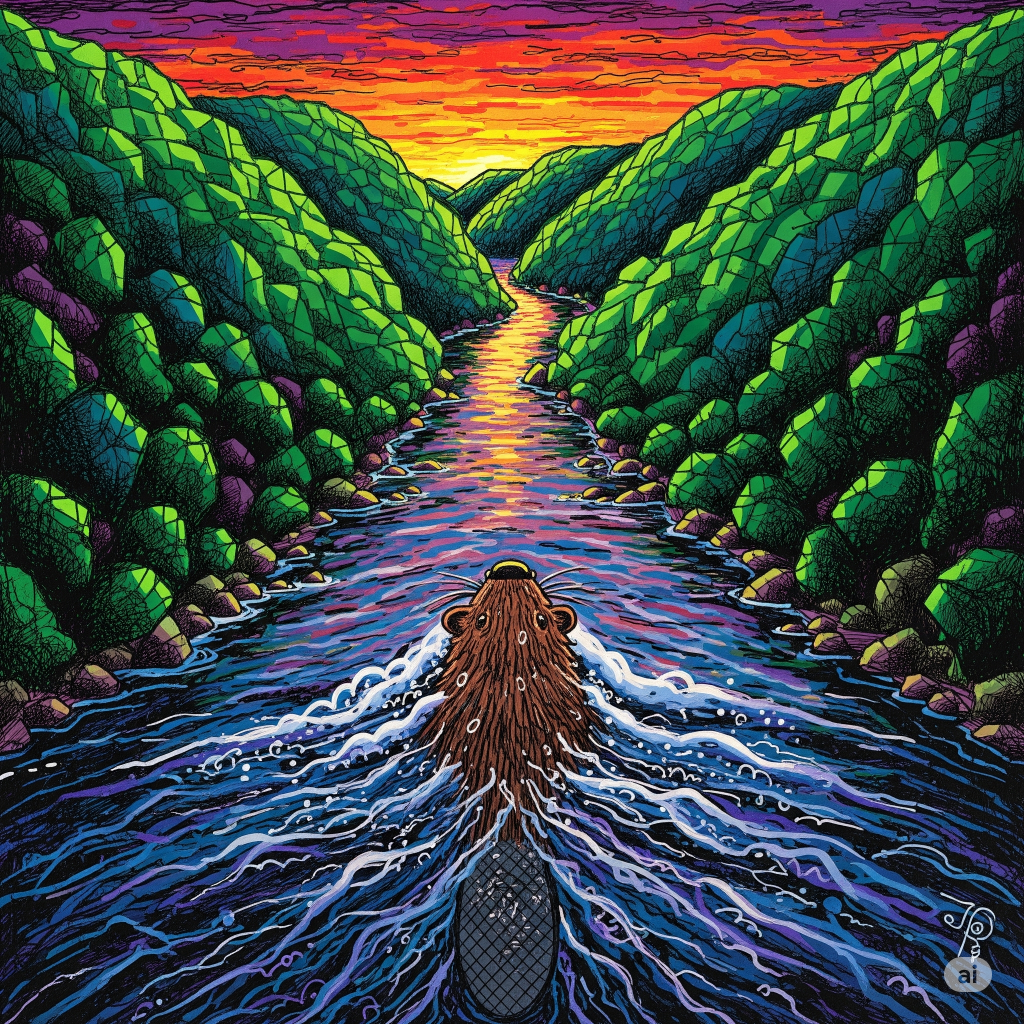
I watch the sunset from the perch of my rusty fold-up chair while sipping a hazy IPA, trying to focus my mind so intently that I’m able to witness the microscopic moments when my surroundings become just a little darker. I give myself pep talks, convinced that if I truly commit, if I quiet my monkey mind and focus on this one thing, that I’ll be able to notice those slippery mini-changes when one thing becomes another. I always fail. I am forever distracted. This specific time, the distraction is some kind of mammal, a beaver perhaps, that I see, out of the corner of my eye, swimming upstream through the blue twilight, its head poking out of the brown water. The rest of its body is submerged, propelling its furry, hot-blooded self onward against the current. Every few seconds, as if to throw off a predator that might be tracking it, the undisclosed beaver-like mammal (on second thought, it might be a groundhog) ducks its head underwater and stays there for five, 10, 15 seconds, before emerging several feet away, sometimes downstream, sometimes up. The creature does this three or four times, until finally it does not reemerge, or if it does, it’s somewhere beyond my range of sight. For all I know, the thing has swum to the bottom of the river and is currently digging its way to the other side of the Earth. Why not?
The sun is completely down now. I’ve missed all of the virtually imperceptible moments of change, yet somehow the entire world around me is utterly dark. Or is it? The separation between daytime and twilight, twilight and night, isn’t as clear-cut as it seems. Beyond the mountains in front of me, to the West, the sky is dimly lit, as if by a dying lightbulb. To my rear, the East, the darkest depth of night has descended, and stars are beginning to reveal themselves, as if an enormous window is being opened across the sky. Directly above me is the Big Dipper, which, along with Orion’s Belt, comprises all the constellations I’m able to identify, which makes me vaguely sad, because I’m sure there are many wonderful constellations out there worthy of recognition that are overshadowed by the big names everyone knows.
In this last gasp of twilight, I take a walk through the riverside neighborhood, which features a peculiar mix of RVs and trailers and beachy-looking homes. I’m sipping my IPA and enjoying the pleasant breeze blowing off the water when an unleashed German Shepherd starts snarling in my general direction from an unkempt front yard; I’m so terrified that the sharp-toothed mongrel might sprint toward me and rip out my throat that I do a quick 180 and powerwalk back to my air-conditioned shack, where I’m safe from any angry thing that might hurt me, where I don’t have to look up at the stars that mock my insignificance with their beauty, their volume, and their impossible distance. I sleep deeply on the uncommonly comfortable cot until a train rumbles through the neighborhood at five in the morning, tooting its horn at full volume as if it thinks all human beings should be nocturnal.
The next morning, as I cautiously open the door to the garage apartment at 5 a.m. to grab my coffee from the mini-fridge, I’m greeted by the sound of a growling wolf from the loft. My stomach drops out of my groin; I think: how did that German Shepherd get in here? A deep voice grumbles garbled nonsense from overhead: the host’s party-loving buddy, perhaps. I recall the random firearm lying on the ground, the empty Mike’s Hard cans, and decide being shot in the chest or mauled to death by a bloodthirsty canine wouldn’t be the best way to spend my last day in Hinton, or on Earth. I shut the door, quickly, and power-walk away from the building like I’ve planted a bomb that’s about to explode.
It’s so damn early. The fog is opaque, the air pleasantly cool. I think: why not spend the morning on a kayak in the middle of Bluestone Lake? There’s a marina that rents them at 15 bucks for two hours, and when I arrive, a guy who I presume works there, given the fact that he takes my payment, tosses an oar and a life vest onto the dock and says: “Have at it.” I nearly capsize the hard plastic kayak while climbing aboard; I don’t have an instinct for the weight distribution, and also there are moments in my life, despite being generally athletic, where the communicative tether between my mind and body is severed. My butt gets slightly damp from cold water pooled in the seat, and this makes me irrationally cranky…probably because I haven’t had any caffeine yet, thanks the gray wolf in the loft that wanted to maul my face, and the possibly hungover guy who wouldn’t have given a second thought about blasting a hole in my chest. I manage to pull it together, despite all of these things conspiring against me, and paddle ahead into the wide-open Appalachian lake.
I turn around and sluggishly paddle back to the marina, stopping every few minutes to absorb the lapping calm and the cool morning air, the volume of traffic on the bridge increasing by the minute, the hot summer sun burning off the last few wisps of fog that hang over the lake like ghosts preparing to cross over to the other side. I haven’t reached Nirvana, but that’s alright: I’ll settle for a dry bum and a hot cup of coffee.
It’s peaceful out there, in the center of the still water. I am mostly alone. If I stop moving and just sit, the only noises I hear are the soft lapping of calm water and the occasional car whooshing over the bridge near the marina. There are a couple of boats out here, but they’re manned by docile fishermen who seem as interested in taking early-morning naps as they are in catching fish. I want to reach a spot on the water where there are no signs of humanity, where I can’t hear the distant whir of traffic. I see a bend in the river up ahead and think: once I get around that corner, that’ll be the ticket, that’ll be the spot where I can fully return to my – our – inborn state of harmony with nature, that’ll be where I can brush away the layers of artificial detachment that have settled on my soul like West Virginia coal dust. If I can just make it up around the bend, away from it all, I’ll obliterate the invisible barrier between myself and the world, I’ll burst into a trillion atoms and disperse into the atmosphere like the non-entity I once was, and will become again, when it’s all said and done.
I paddle, and paddle, and paddle some more, and finally I’m forced to concede that I’m never going to make it. My eyes have fooled me once again: I couldn’t swim out to that island yesterday, I won’t be able to make it up around the bend today. I could push it, strive for it, but the two-hour time limit ticks away in the back of my mind like a grandfather clock. Despite my idealistic urge not to care about money, I do, because I’m beholden, always will be beholden, to the values of the society I’ve been born into. The expectations that accompany this truth smolder in the back of the brain at all times. I turn around and sluggishly paddle back to the marina, stopping every few minutes to absorb the lapping calm and the cool morning air, the volume of traffic on the bridge increasing by the minute, the hot summer sun burning off the last few wisps of fog that hang over the lake like ghosts preparing to cross over to the other side. I haven’t reached Nirvana, but that’s alright: I’ll settle for a dry bum and a hot cup of coffee.
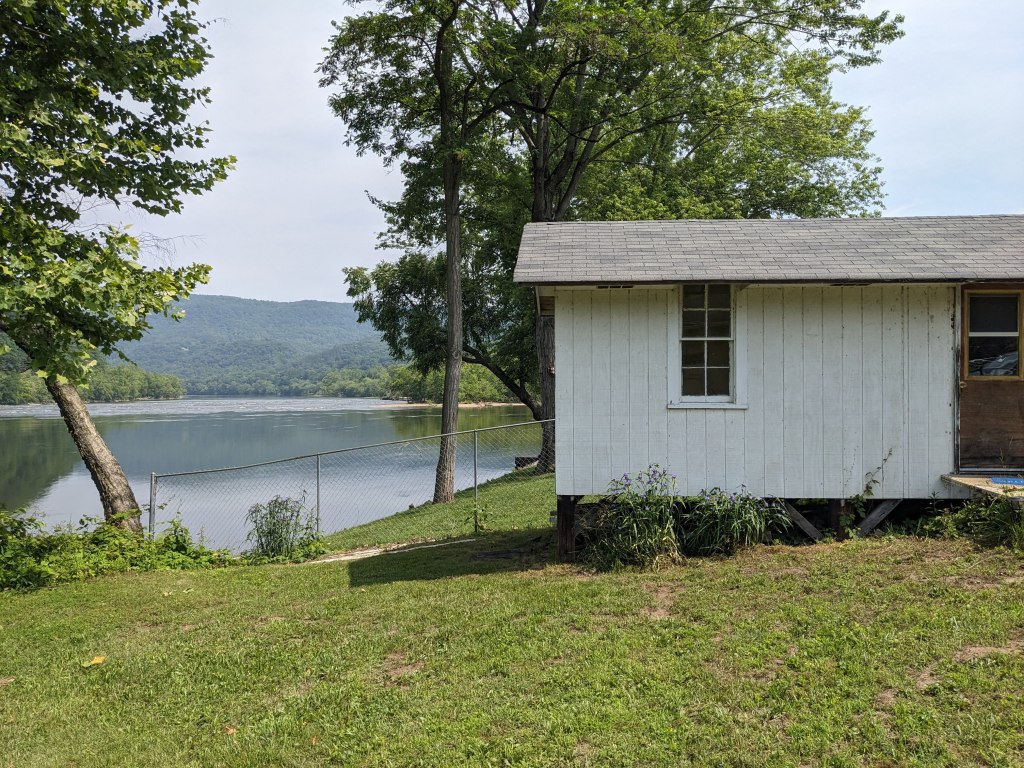
The fabled river shack. 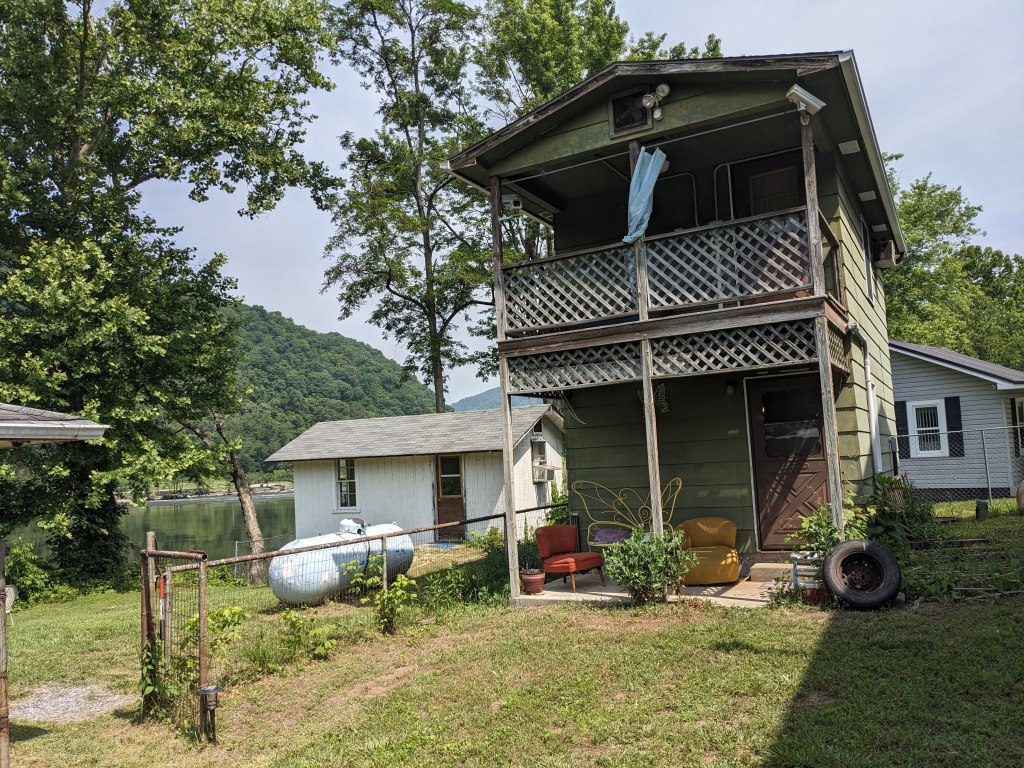
The garage apartment, inside which I had a brush with certain death. 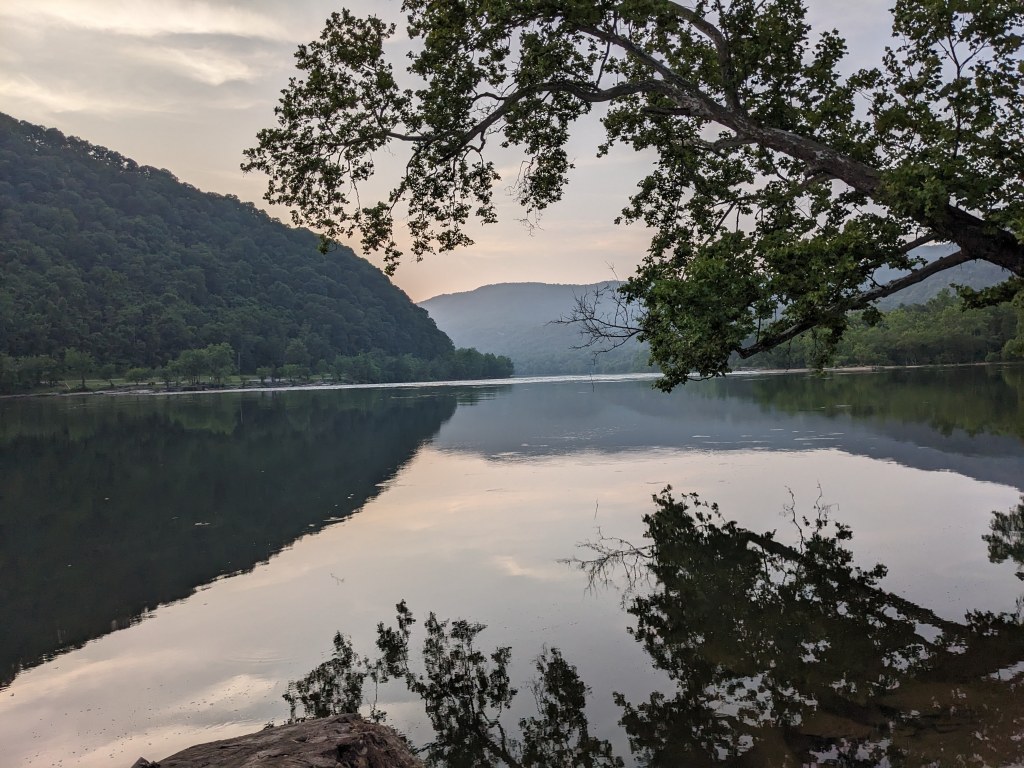
View of the New River from the dock near the river shack. 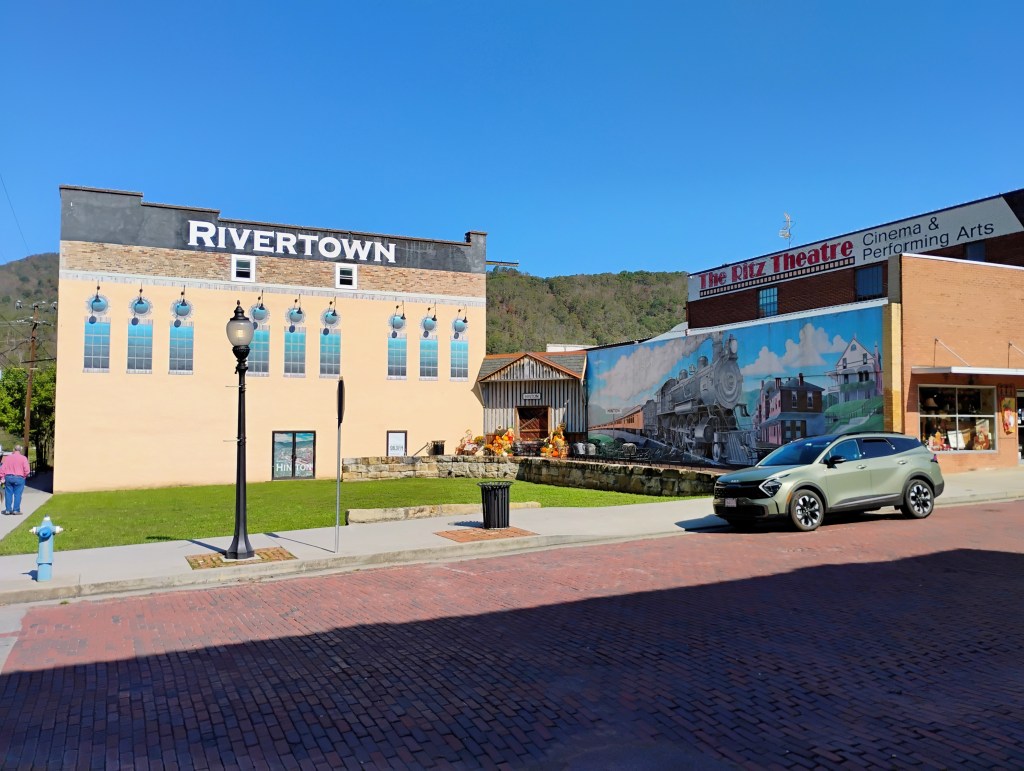
Downtown Hinton. 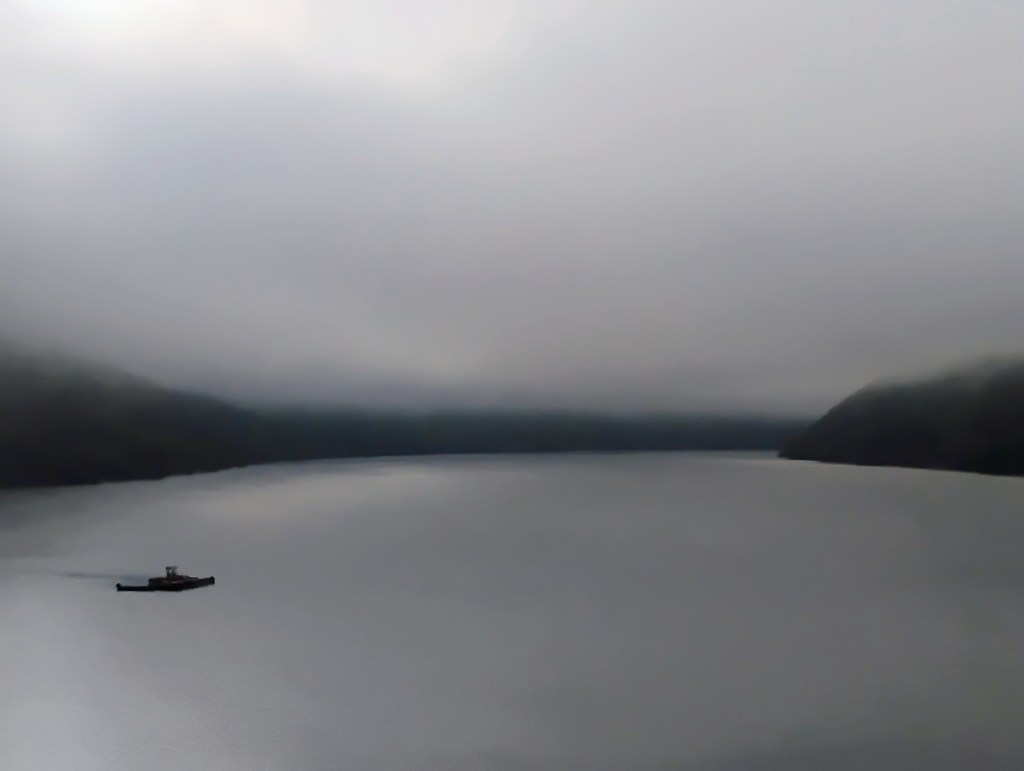
Bluestone Lake on a foggy morning. 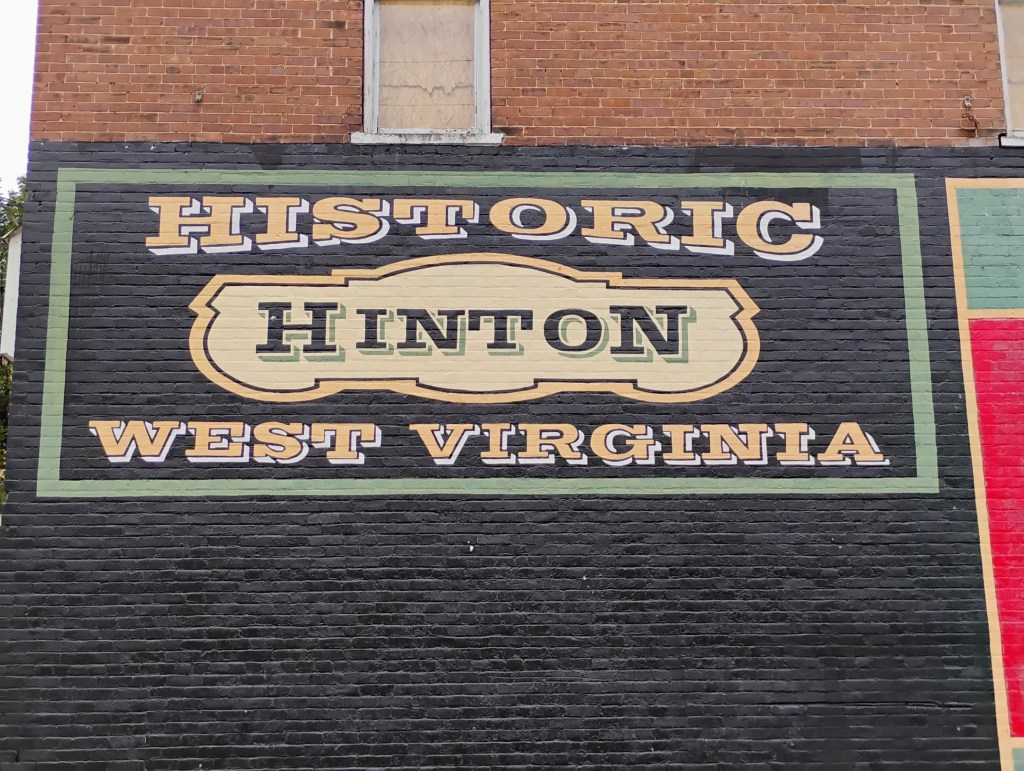
A sign in downtown Hinton. 
Old school Coke sign in Hinton. 
Frothing and foaming Sandstone Falls. 
The New River, near Sandstone Falls. 
A cartoon map of Hinton. 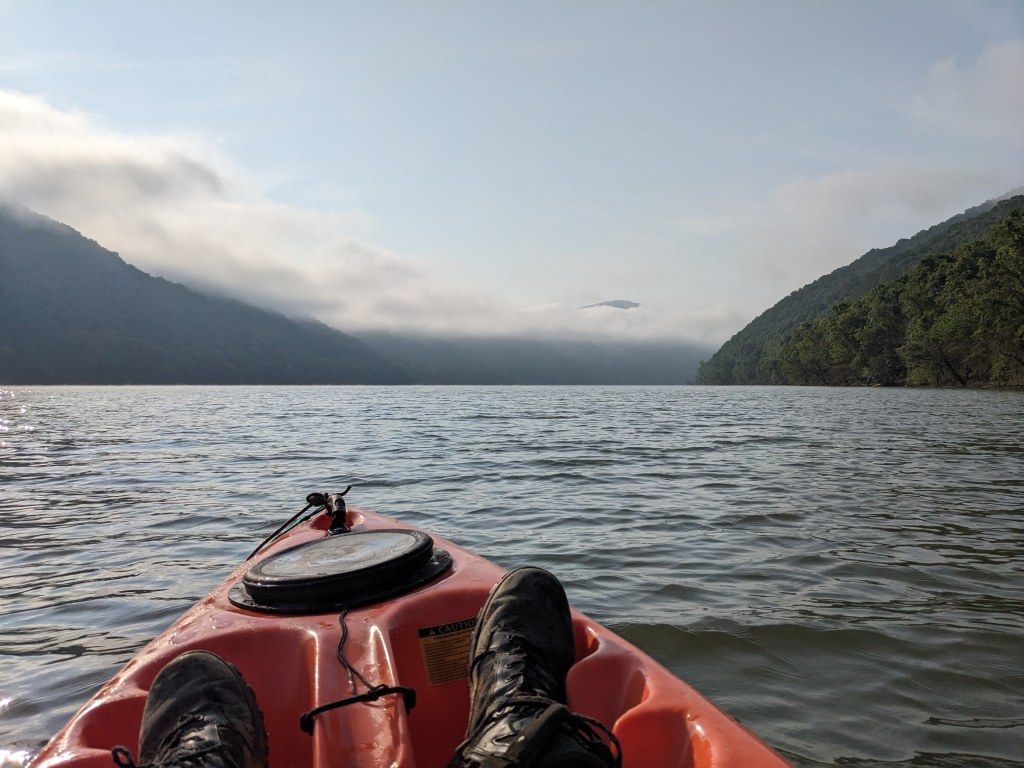
Alone on a kayak in Bluestone Lake.

 Ourland
Leave a comment